



Hello everyone,
The purpose of this letter is to inform you about the current situation of the crypto-asset market, as well as recent news in this field. This letter is not investment advice, but merely a sharing of my personal point of view.
News
Sam Bankman-Fried has been arrested and is expected to be extradited to the United States. The charges against Sam Bankman-Fried include wire and securities fraud, conspiracy to commit wire and securities fraud, and money laundering.
In a press release, the Prime Minister of the Bahamas, Philip Davis, states: « The Bahamas and the United States have a shared interest in holding accountable any individuals associated with FTX who may have betrayed the public trust and broken the law« . Follow the evolution of the FTX situation in real time.
–
Cryptocurrency buyers have quadrupled since 2020. A study led by JPMorgan reveals that the number of cryptocurrency buyers in the United States has quadrupled since the COVID-19 crisis. The financial group estimates that the number of people who have invested in this type of asset has risen from 3% to 13% of the U.S. population.
–
The European Union is going to limit cash payments to 10,000 euros. Late last week, the European Union decided to limit cash payments to 10,000 euros in order to combat money laundering and terrorist financing. Cryptocurrency transactions exceeding 1,000 euros will also be subject to greater monitoring. As a reminder, cash payments are already limited to 1,000 euros in France.
–
Without the Merge, one million ETH would have been created with an Ethereum PoW. Data shows us that if the blockchain had remained on proof of work, more than one million additional ETH would have been created.
In a PoW model, it would therefore be approximately $1.28 billion in money supply reportedly createdProjecting the data on an annual basis, this would be equivalent to 3.06 % of inflation for 3.7 million new ETH.
But thanks to a transition to a PoS consensus, that is no longer the case. With the current state of the Ethereum blockchain, the network would even be deflationary taking the data on a daily basis, i.e. -0.47 % per year, and neutral when taking data over 30 days. (Source: https://ultrasound.money/).
–
Binance Audit: Bitcoin (BTC) held by the platform is overcollateralized. Another proof of Binance's solidity? The platform has just completed its reserve audit, and the expertise reveals that Binance's Bitcoin (BTC) reserves are slightly larger than what was announced. This should reassure users who feared another FTX-like scenario. View the live reserves of certain exchanges on Nansen: https://portfolio.nansen.ai/entities.
–
Ledger Stax: Ian Rogers compares the cryptocurrency ecosystem to the early days of the Web. Ian Rogers, Chief Experience Officer at Ledger, looked back at the genesis of the brand's new hardware wallet: the Stax. To do this, he draws a parallel between the current development of the cryptocurrency ecosystem and the early days of the Web.
«In the 1990s, people said, “Not everyone will ever have broadband!” Ten years later, the same people said, “Not everyone will ever have a smartphone!” Yet today, humanity collectively uses more than 6.5 billion internet-connected smartphones to live its daily life.»
Ian Rogers, Ledger's Chief Experience Officer
Fundamental Analysis
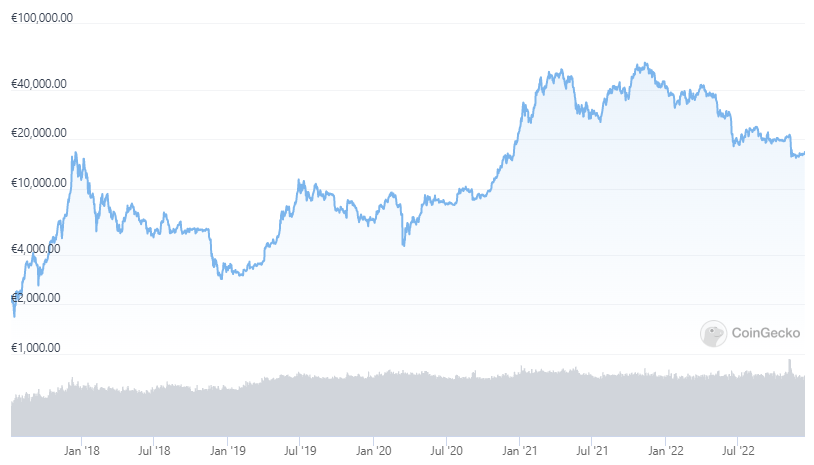
Source : https://www.coingecko.com/fr
At the time of writing, the price of Bitcoin is 17,950 $ (December 14, 2022).
We are approaching the end of 2022. This year has been one of the most difficult and brutal for the ecosystem, as well as for the broader financial markets. With central bank monetary policies making 180-degree turns in response to inflation, and after decades of extremely loose and easy credit conditions, the tightening has caused severe and rapid declines across most asset classes.
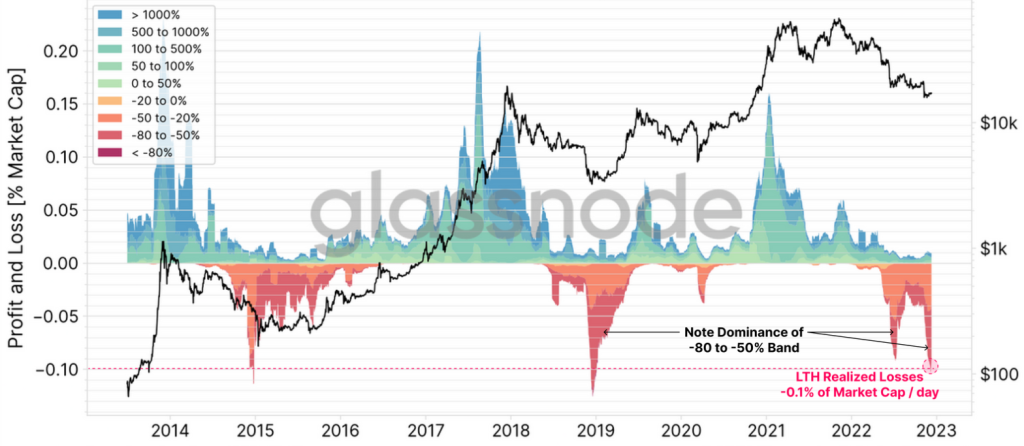
We are currently at extreme unrealized loss thresholds for long-term holders. As we can see in the chart below, history repeats itself in every cycle. This one took the form of a double peak during the UST collapse events, followed by FTX. We are at maximum pain thresholds for holders, but also at very interesting long-term buying points.
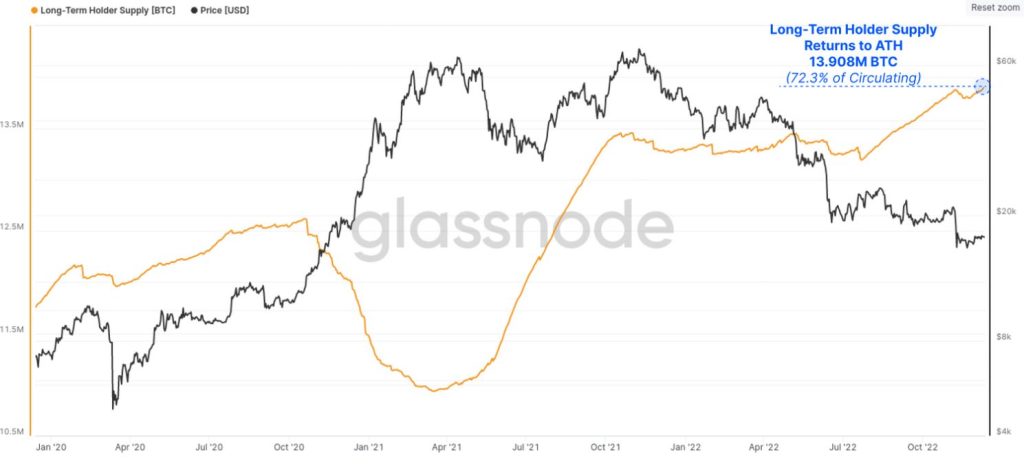
Adopt a long-term vision. Despite these spectacularly large losses, the age of the BTC coin supply as well as the propensity to accumulate tokens by those who remain convinced, continue to increase. Regular buyers have already completely absorbed the panic spending during the FTX collapse. The upward trend on this metric has been almost linear for nearly 6 months.
We witnessed the deleveraging of DeFi. The sharp contraction of liquidity in the global economy, but also in the crypto ecosystem, significantly reduced the TVL (Total Value Locked) from a peak at 160 billion dollars in November 2021, at 40 billion currently. This creates interesting opportunities in most high-quality DeFi projects that will be around for subsequent cycles. Contrary to what is heard in many media outlets, cryptos have not failed; only the flaws of CeFi (centralized finance) have created setbacks for the industry. Blockchains and DeFi work very well and continue to develop.
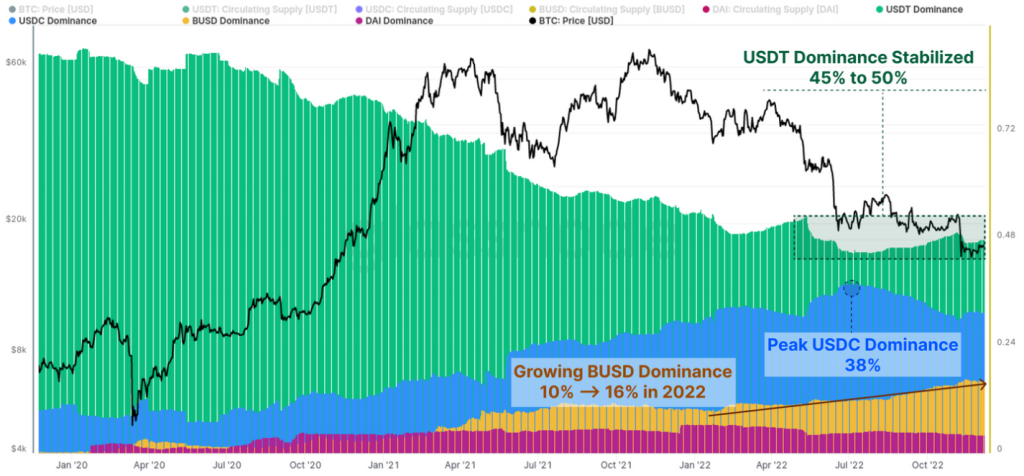
We are witnessing fierce competition for the relative dominance of stablecoins among USDT, USDC, BUSD, and DAI. This competition is healthy for the ecosystem and prevents any players from becoming too systemic for the industry. Unfortunately, decentralized stablecoins are struggling to carve out a significant place in this market.
–
Inflation in the United States is down again this month, from 7.7 % to 7.1 %. Core inflation (excluding food and energy) is also down, from 6.3 % to 6 %. The Fed has slowed its rate hikes and is currently at 4,5 %. Markets are awaiting the Fed's pivot. At the same time, the dollar has stopped its unsustainable rise and has begun a correction.
In Europe, not only are we not done with inflation (and the ECB's rate hikes will not be enough to defeat it), but moreover, we are now in a recession. We talked about this recession several months ago in a previous letter. This means that in Europe, we have both disadvantages: recession and inflation. A cocktail that will be painful for Europeans.
A recession means a drop in economic activity and therefore a drop in corporate turnover. Furthermore, inflation means a drop in profit margins for businesses. Added to higher energy costs, European companies risk going bankrupt everywhere.
Inflation erodes all future corporate profits, primarily those of companies growing through debt. The crypto-asset industry should perform well in the coming years with inflation and a recession.
First of all, because the majority of digital assets in the ecosystem are protected from inflation, due to their nature and limited supply. But also because these assets do not require debt to develop: thus, they do not need low interest rates to grow. in the long term.
Only adoption and use cases will be their growth engine. The abundance of liquidity was an added advantage, but it is not necessary for their intrinsic development, unlike many growth companies (tech) that are heavily dependent on debt.
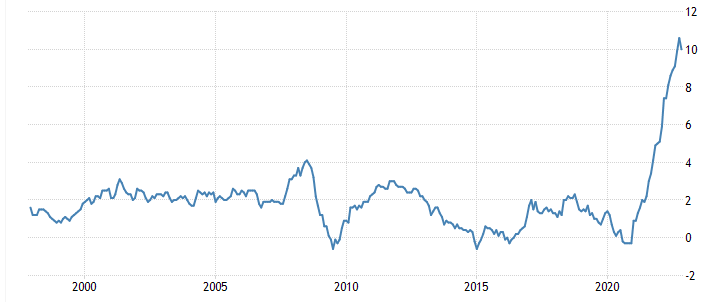
Unfortunately, inflation in Europe will be persistent.
If you have any questions, comments, or would like to know more about our service, please feel free to contact us: tristan.g@crypto-assets-management.com
— Warning —
This is not investment advice, no one can predict the future.
You are solely responsible for your investment decisions.
We are not responsible for any losses resulting from a decision made based on the information in this letter.