



Hello everyone,
The purpose of this letter is to inform you about the current situation of the crypto-asset market, as well as recent news in this field. This letter is not investment advice, but merely a sharing of my personal point of view.
News
The Merge represents the migration of the Ethereum (ETH) blockchain to a new consensus method. This merge is one of the most impressive technical feats in the crypto-asset industry, and the event is fast approaching. The merge marks the culmination of many years of research, engineering, and development, and will transition the Ethereum blockchain from a proof-of-work (PoW) to a proof-of-stake (PoS) consensus mechanism.
In many ways, this event could be considered the equivalent of changing an aircraft's internal combustion engine to an electric motor while in flight! This $200 billion aircraft, which also carries hundreds of billions of dollars in financial infrastructure, while traveling at full speed.
The merger was officially scheduled for tonight. Find out the exact date and time of the Ethereum update here: https://cryptoast.fr/the-merge-countdown-timer-date-heure-exact/
–
THE MERGE: Why is Ethereum becoming the favorite project of banks? Maneuvers are accelerating as The Merge approaches. On September 7, SEBA Bank, which is regulated by the Swiss authorities, launched Ethereum staking for its institutional clients. Through its new offering, SEBA Bank is increasing Ethereum adoption by institutional investors, who will be able to« play a key role in securing of the network's future, via a trusted, secure, and fully regulated counterpart », according to Mathias Schütz, head of technology and solutions for the bank.
–
The Bank of Russia is considering legalizing cross-border cryptocurrency payments. As part of a television interview, the Bank of Russia, historically opposed to cryptocurrencies, has finally rethought its approach to the point of showing favorable to the use of this type of asset for cross-border payments. The Deputy Minister of Finance of Russia Alexei Moiseev stated that he was « now impossible to do without cryptocurrency payments »given the current geopolitical context, the crypto industry could never have imagined this statement just two years ago; certain use cases have become interesting for major institutions and countries.
–
Bitcoin (BTC): MicroStrategy wants to raise 500 million dollars to finance its investments. Through a stock sale, MicroStrategy hopes to raise up to $500 million to invest a portion of these funds in Bitcoin (BTC). At the time its document was prepared, MicroStrategy was still holding 129,699 bitcoins. Their average acquisition price is announced at $30,664 per unit. Private or public companies continue to acquire Bitcoins over the long term, which is a sign that despite the bear market, professionals continue to be convinced of the fundamentals and the adoption of this industry. Here is a site that allows you to visualize the amount of Bitcoin held by different parties (private and public companies, countries, ETFs).
–
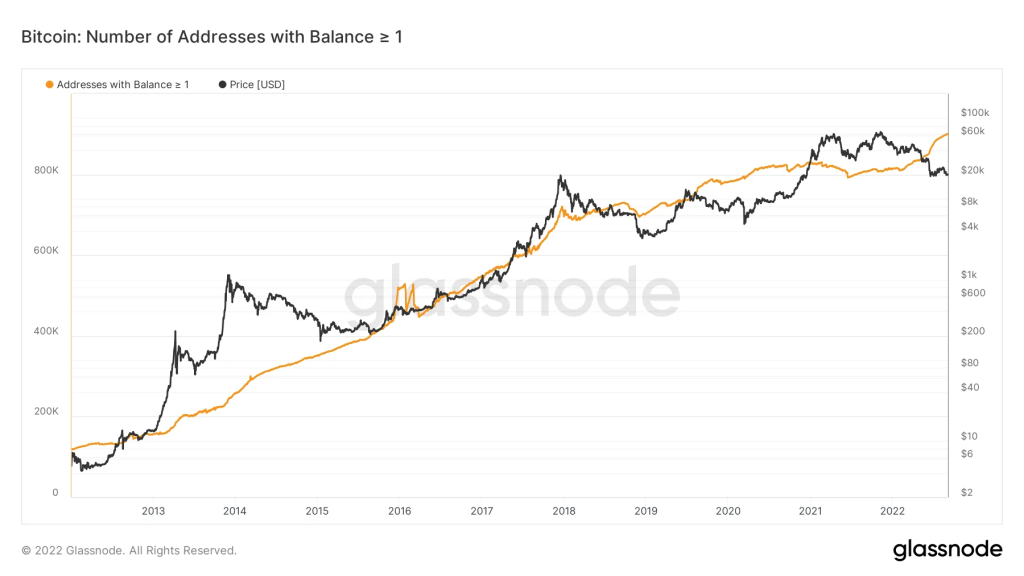
Does Bitcoin have a better wealth distribution than the current system? While the number of addresses holding more than one bitcoin (BTC) continues to increase, we will try to determine whether the distribution of bitcoins is more equitable than the distribution of wealth in the current world. Thus, relative to its users, The percentage of addresses holding at least 1 bitcoin is higher than the percentage of millionaires worldwide, at 2.11% and 0.71%, respectively.. These figures should be taken with a grain of salt, of course; they are approximations.
On the other hand, it can be stated thatThe number of addresses holding at least 1 bitcoin (BTC) continues to increase. He even surpassed the 900 000 a few days ago. Below is a chart from Glassnode showing, in orange, the number of addresses holding 1 bitcoin and in black, the price of bitcoin.
Fundamental Analysis
Source : https://www.coingecko.com/fr
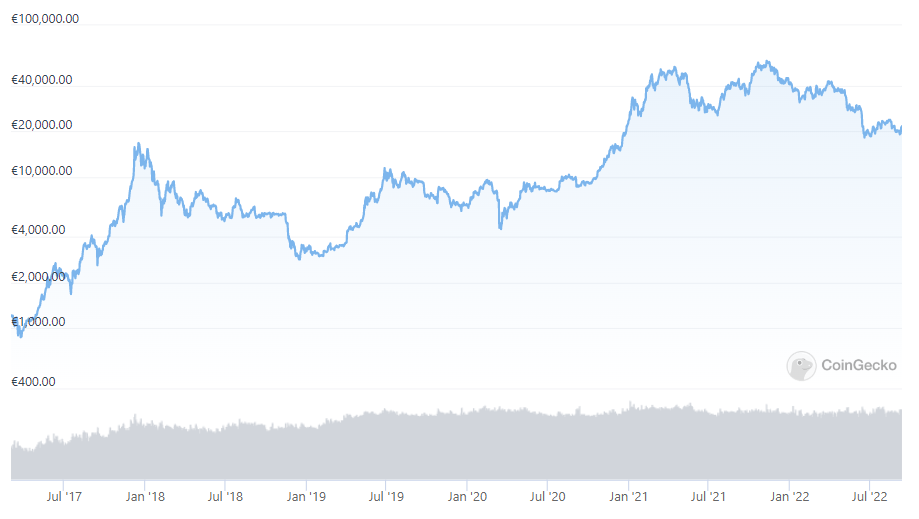
At the time of writing, the price of Bitcoin is 22,100 $ (on 9/12/22).
As we pointed out in the last newsletter, caution was warranted for the September return. A downward phase even began in late August, with the market correcting the summer bull run by hitting a low around 18,300 $, thereby creating a double bottom around this area nearly 3 months apart (June and September). For a week now, the market has been climbing back up as the Ethereum update approaches.
No one can predict with certainty the end of the bear market, but many indicators tell us that we are very close to the end of this downward cycle (see letter No. 15). Perhaps the Ethereum network's update (The Merge) will be a bullish catalyst to end this bearish cycle. It will also depend on macroeconomic trends: we must not forget that the crypto-asset ecosystem is still just a drop in the ocean of the global economy.
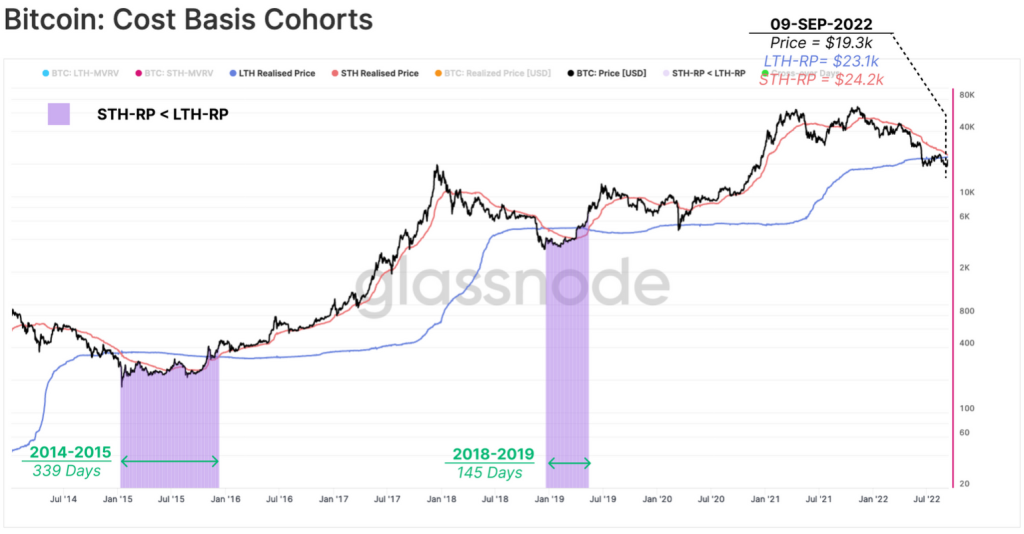
It is likely that by the end of the year, we will have exited this bear market above the realized price (*) for long-term holders, see the blue curve below.
*The realized price is an on-chain metric that measures the price of BTC at the time of its last movement.
We believe that in the coming months, there will be a decorrelation between the stock and crypto markets. We believe this for several reasons:
- First of all, because equity markets still have downside potential, which is less the case for Bitcoin and major cryptocurrencies, which have returned to their fundamental values according to many indicators (see letter No. 15).
- Then, because we believe that central bank interest rates, which are currently rising, greatly impact companies in the long term, since these companies grow with debt. On the other hand, crypto-assets do not require debt to grow. We can think (in the long term) that the increase in rates will not impact them.
To illustrate my point, let's take the example of Tesla, which wants to open a new factory in a country: the company will then create debt to build it and develop its business. If this debt costs it more today (with the increase in key interest rates), then it will abandon the project for its new factory, and this will reduce its growth.
The crypto-asset industry doesn't work like that: it is primarily adoption, usage, and the building of use cases that create the long-term growth of cryptos, not debt.
However, in the short term, when key interest rates rise, risky assets fall.
–
The ECB is raising its key interest rates from 0 to 0.75 % to fight inflation and bring it back to its 2% target, which is the sole goal of its mandate. This rate hike is insignificant for defeating the euro area's current inflation rate of 9.1 %, At a minimum, rates should be as high as inflation, which is to say 9 %. To maintain economic stability in Europe and avoid excessively large rate differentials among European countries, the ECB cannot afford to raise rates that high. Inflation will probably be here for the long term and significantly above 2 %.
–
It must be noted that in Europe, despite the lack of official announcements, we are already in a recession (definition: temporary period of economic contraction in a countryThe question is to know the intensity and duration of this recession?
With recent events, notably the complete cutoff of gas supplies from Russia, we can be certain that this recession will not be mild. The economy is nothing more than transformed energy. If Europe's energy supply is cut by 10 %, then the European economy will decline by 10 %. Many companies in France and Europe will go bankrupt or temporarily shut down production because the price of gas (and electricity) is inelastic. If there is a availability of 100 and demand is 101, then prices will skyrocket until the (1) excess can no longer pay for its energy (the economically weakest) and demand is back to 100.
Price controls from our politicians won't save us, they only postpone and amplify the problem.
Some tips for individuals: maintain a lifestyle suited to your wealth, be economical to prepare for this recession, consume little and wisely, plan your energy sources in advance for the winter if they can be stored, preserve your capital in scarce assets (gold, real estate, crypto...).
The crypto-asset ecosystem will be very minimally impacted by this event, first because it is a global market, and also because it requires little electricity for all cryptos that operate on Proof of Stake. For cryptos that operate on Proof of Work (notably Bitcoin), their mining does not take place in Europe, nor at the expense of human electricity needs. Mining is developing primarily near areas of energy surplus. It is also developing at oil sites to replace gas flaring or towards underdeveloped countries that are rich in energy but lack the infrastructure to use it.
If you have any questions, comments, or would like to know more about our service, please feel free to contact us: crypto.assets.manage@gmail.com
— Warning —
This is not investment advice, no one can predict the future.
You are solely responsible for your investment decisions.
We are not responsible for any losses resulting from a decision made based on the information in this letter.