



Crypto Assets Management – Mereau Finance
Company registered as a DASP with the AMF under the number E2023-084
Trade and Companies Register of Nanterre: 894 424 902
Address: 35 rue Jean Jaurès, 92800 Puteaux
Date : 06/26/25
DISCRETIONARY PORTFOLIO MANAGEMENT
OUR VISION
We are committed to supporting you on a personal level in your long-term digital asset investment. In this volatile and risky asset class, a calm and sustainable approach is essential.
«Digital assets are to the transfer and storage of value what the Internet was to the transfer and storage of information.»
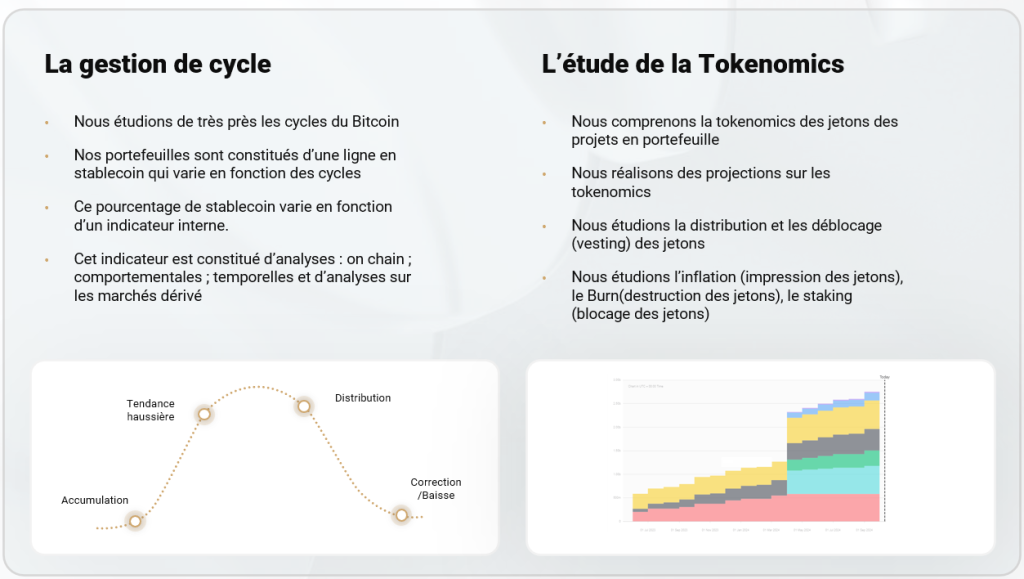
OUR STRATEGY IS BASED ON TWO PILLARS
OUR INVESTMENT PHILOSOPHY
Our investment approach is based on identifying highly efficient projects with strong fundamentals. We meticulously analyze their tokenomics to spot potential market anomalies. Our selection focuses on top 200 projects by market capitalization, with a medium-to-long-term vision, covering various sectors of the crypto ecosystem.
PLASMA – Research Report
Plasma: The new chain redefining stablecoin payments
Why are we deciding to talk about it?
Plasma has established itself as one of the most closely scrutinized blockchain projects of 2025, after raising $1 billion in record time. Initially, 10 % of the XPL token supply was put on sale on Sonar, Echo's new platform dedicated to public fundraisings for early-stage projects. Within minutes, $500 million was raised.
But it was what followed that came as a surprise: a second 500M$ sale was quietly opened a few hours later, and it too was quickly oversubscribed. This double success confirms the massive investor interest in a project still in its deployment phase, yet already backed by heavyweights like Bitfinex, hiFramework, and Founders Fund. It is also worth noting: Plasma is considered the “Tether chain,” the stablecoin giant, which further strengthens its strategic status in the ecosystem.
What is Plasma?
Plasma is a high-performance blockchain designed specifically for stablecoin payments. While general-purpose blockchains sometimes struggle to handle stablecoin requirements (congestion, high fees, lack of fast finality), Plasma is built from the ground up to address these constraints. The project aims to become the reference infrastructure for stablecoin transfers, with technical characteristics aligned with this goal.
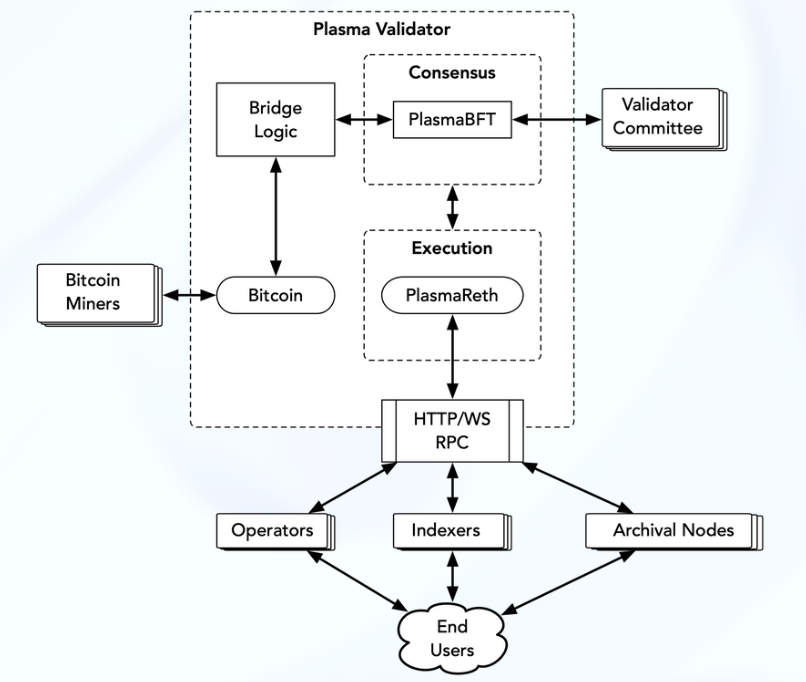
Under the hood, Plasma is based on:
- PlasmaBFT, a consensus protocol inspired by HotStuff, optimized for fast finality and low latencies.
- Reth, an EVM-compatible execution engine in Rust, allowing the deployment of Ethereum contracts without modifications.
- A native Bitcoin Bridge, which ensures synchronization with the Bitcoin chain while enabling payments denominated in BTC or USDT via «Custom Gas Tokens.».
With a team hailing from Microsoft, Apple, Goldman Sachs, and research institutions such as Imperial College and Los Alamos Lab, Plasma combines technical innovation, an institutional network, and ambitious execution.
An infrastructure designed for the stablecoin era
The context: a colossal market in transition
Stablecoins, which are digital currencies pegged to a fiat currency (most often the dollar), have established themselves as one of crypto's most fundamental use cases. They combine value stability, 24/7 availability, and programmability, making them ideal instruments for payments, settlements, and financial operations without depending on the traditional banking system.
With a market capitalization of more than $225 billion, stablecoins already account for 1.08 % of the M2 money supply in USD, a figure set to grow significantly with the evolution of regulatory frameworks and institutional adoption.
Initially used for crypto-to-crypto trading, stablecoins have established themselves as settlement and yield-generation instruments. Today, two blockchains concentrate most of the activity:
Tron (~63 billion $): optimized for settlement, but ultra-centralized
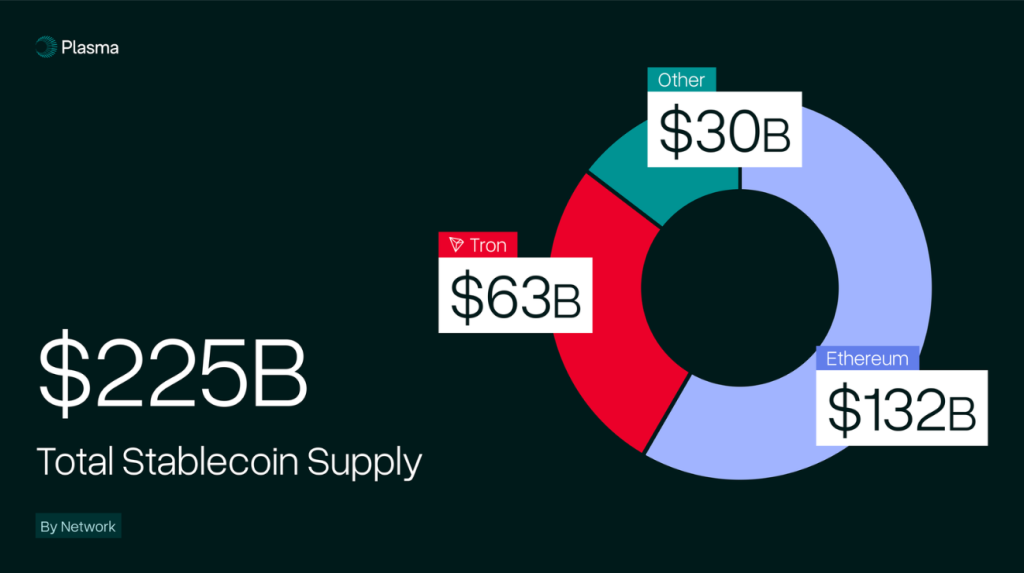
Despite their massive adoption, neither Ethereum nor Tron was designed for stablecoins. These chains present structural limitations: fees, slowness, lack of rapid finality, or native functions dedicated to the issuance and management of stablecoins.
This situation creates a strategic vacuum. While stablecoins are evolving toward large-scale uses (international transfers, payroll, commercial settlements), no truly dedicated infrastructure has yet emerged to support their global adoption.
In this context, the demand for a specialized blockchain capable of meeting the specific technical constraints of stablecoins is becoming increasingly evident.
It is precisely this positioning that Plasma aims to capture.
Plasma's proposal
Plasma is a next-generation blockchain, natively designed for stablecoins. Where Ethereum and Tron were repurposed from their initial use cases to accommodate this market, Plasma is specially architected to maximize its potential: low-cost payments, yield, institutional integrations, and high-frequency settlements.
Plasma is built on a tech stack optimized from the ground up:
- PlasmaBFT consensusa protocol derived from HotStuff, offering fast finality, low latency, and resilience, tailored for frequent and critical value transfers such as those of stablecoins.
- Reth execution enginefull compatibility with Ethereum (EVM), while introducing performance optimizations in Rust.
- Native Bitcoin bridgePlasma maintains direct synchronization with Bitcoin, enabling hybrid use cases, such as paying fees in BTC or security anchoring.
Unlike traditional L1s, Plasma introduces product-oriented features to make the use of stablecoins smooth and native:
- Custom Gas Tokensusers can pay fees in USDT, BTC, or other popular assets, removing the need to buy a native token to interact with the network.
- Fast completion and low cost: indispensable for use in payments, transfers, settlements, or financial automation.
- Native Bitcoin interoperability: reinforcing the network's legitimacy and utility for institutions already positioned in BTC or USDT.
Plasma does not just target crypto users. The goal is to appeal to stablecoin issuers, fintechs, Banking-as-a-Service providers, and on-chain financial infrastructures. The technical architecture is designed to support these integrations: fiat ramps, settlement APIs, integration with corporate treasury systems, and compatibility with financial professionals' tools.
This strategy is supported by a unique positioning in the ecosystem: Plasma is considered the “Tether chain,” meaning the infrastructure most aligned with the interests of the world's most dominant stablecoin issuer. Even though the team remains cautious in its communication, the strategic proximity to Tether and Bitfinex, combined with the fundraising conducted via Sonar (Echo's platform), reinforces this perception.
If Plasma succeeds in establishing itself as the base layer for stablecoin transfers, it could catalyze a set of dynamics:
- Standardization of cross-chain payments in USDT,
- Deployment of new ultra-optimized DeFi primitives for stablecoins,
- Integration with fintechs seeking performance and regulation,
- And above all, massive reduction of adoption friction for end users.
By focusing on a clear specialization around stablecoins, Plasma is positioning itself as a particularly promising infrastructure. It could leverage the ongoing massive adoption of stablecoins and establish itself as a benchmark for both crypto-native players and fintechs and companies looking to integrate stablecoins into their ecosystems.
CONCLUSION
We see in Plasma one of the most promising initiatives in building an infrastructure dedicated to stablecoins. Focusing exclusively on this use case (payments, settlements, and yields), Plasma provides a targeted response to the structural limitations of general-purpose blockchains like Ethereum or Tron.
With a robust architecture (PlasmaBFT, Reth, native Bitcoin bridge) and product-oriented features (Custom Gas Tokens, EVM compatibility, fast finality), Plasma is already positioning itself as a credible technical solution to support the growth of stablecoins. Its strategic alignment with Tether and the institutional interest it generates reinforce its legitimacy.
Certain points, however, still need to be monitored. The token economy of $XPL will need to demonstrate its ability to create true alignment with network users. Similarly, the concentration of sales via Sonar and the lack of clarity around future governance deserve special attention.
Despite these factors, we consider $XPL to be an asset with high potential (provided the tokenomics support it), at the heart of a rapidly growing market. Plasma could become a centerpiece in tomorrow's tokenized financial infrastructure.
If you would like to download the report as a PDF:
Author's note :
My name is LittleGhost. I spend my days studying DeFi, reading governance proposals, and figuring out how to build something truly sustainable in this booming ecosystem.
If you would like to continue following my work:
📺 YouTube : LittleGhost
🐦 Twitter/X : @0xLittleGhost
Thank you sincerely for taking the time to read this report, and see you very soon for new analyses.
Our service
At Crypto Assets Management, we offer discretionary portfolio management of digital assets, tailored to your profile. Our strategy is based on the analysis and management of Bitcoin cycles (historically 4 years), favoring investments in long term, monthly arbitrations, and a particular emphasis on tokenomics.
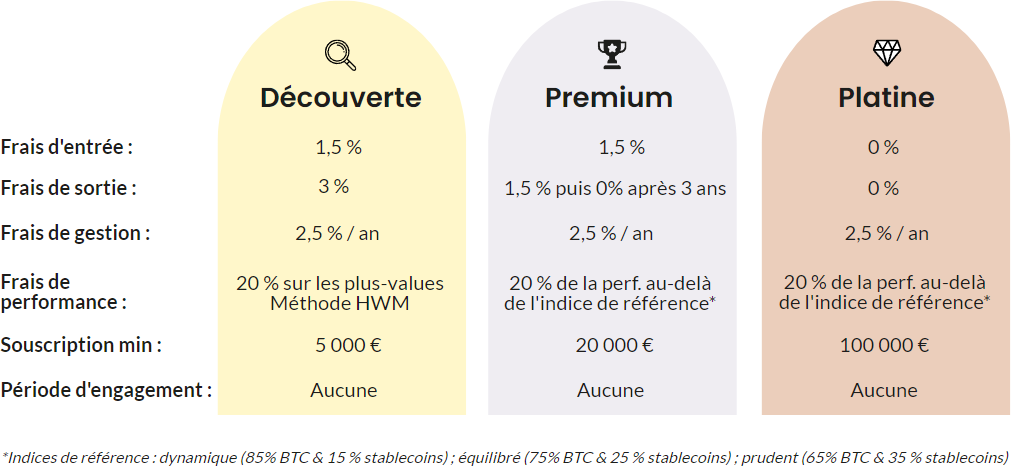
Our Rates

We are saved with the AMF under the registration number for digital asset buy/sell activities against legal tender and digital asset exchange against other digital assets: E2023-084.
— Warning —
This letter is not investment advice.
You are solely responsible for your investment decisions.
Investing in digital assets carries a risk of capital loss, partial or total.