

Crypto Assets Management – Mereau Finance
Company registered as a DASP with the AMF under the number E2023-084
Trade and Companies Register of Nanterre: 894 424 902
Address: 35 rue Jean Jaurès, 92800 Puteaux
Date: April 29, 2025
DISCRETIONARY PORTFOLIO MANAGEMENT
OUR VISION
We are committed to supporting you on a personal level in your long-term digital asset investment. In this volatile and risky asset class, a calm and sustainable approach is essential.
«Digital assets are to the transfer and storage of value what the Internet was to the transfer and storage of information.»
OUR STRATEGY IS BASED ON TWO PILLARS
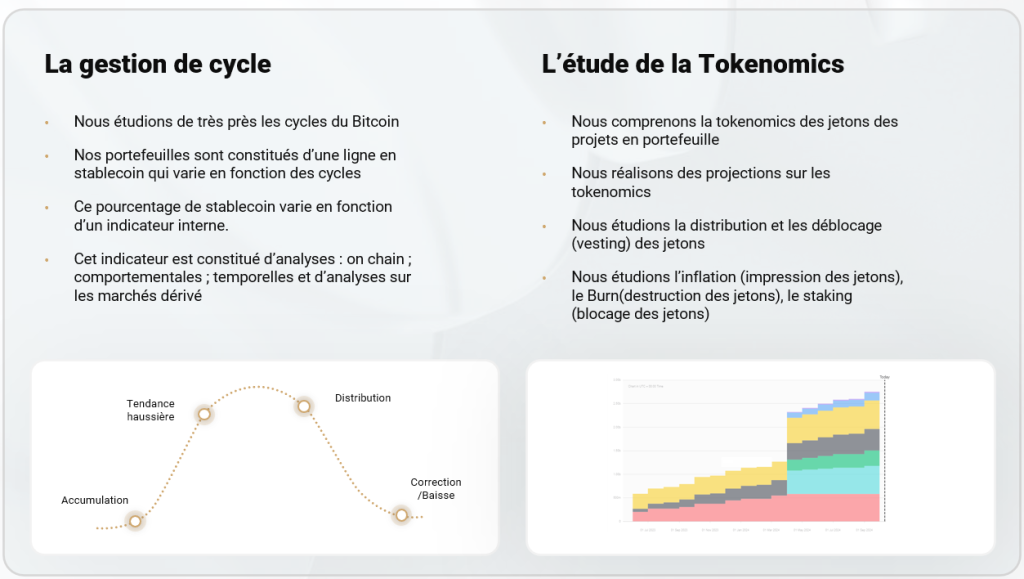
OUR INVESTMENT PHILOSOPHY
Our investment approach is based on identifying highly efficient projects with strong fundamentals. We meticulously analyze their tokenomics to spot potential market anomalies. Our selection focuses on top 200 projects by market capitalization, with a medium-to-long-term vision, covering various sectors of the crypto ecosystem.
Our thesis today is based on the following idea: Aave is currently the beating heart of DeFi. And as this finance structures itself, connects to the real world, and attracts institutional flows, Aave is ideally positioned to capture this value, placing the AAVE token at the center of this dynamic.
Aave (AAVE) – Research Report

AAVE, A FINANCIAL INFRASTRUCTURE IN ITS OWN RIGHT
Aave is no longer just a lending protocol. Over the years and through various versions, it has become a foundation for decentralized finance.
Originally a simple P2P lending platform, it has transformed into liquidity pool-based protocol, and then in interoperable multichain infrastructure, governed by a Dynamic DAO.
Today, the protocol operates on 14 blockchains, with independent markets.
Each evolution of Aave has served a clear purpose: develop a decentralized monetary structure, capable of absorbing the financial uses of the blockchain, while guaranteeing transparency, security and community governance.
One of the best indicators of trust in a DeFi protocol is the Total Value Locked (TVL). Aave far outperforms its competitors:
- 27.9 billion $ the TVL, i.e. nearly 50 % of the total liquidity of the decentralized lending market.
- By comparison, Spark and Morpho each reach 3.4 billion $, or eight times less Aave.
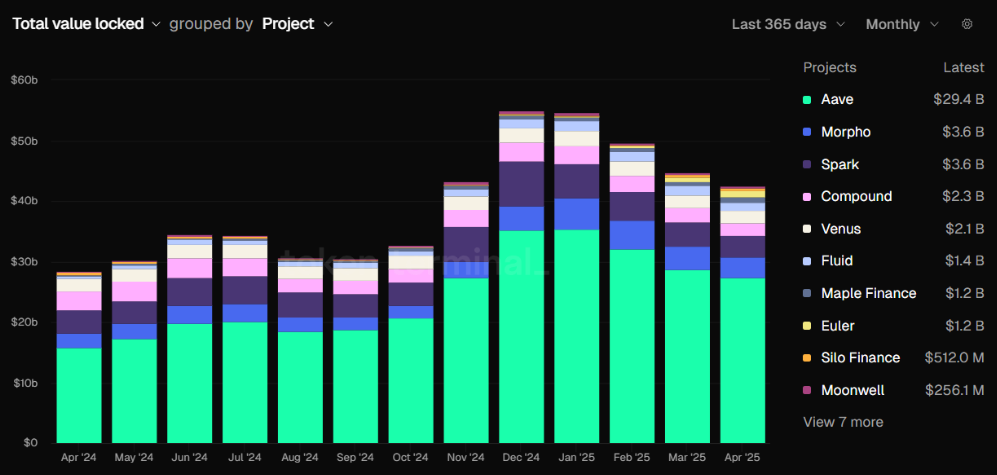
This structural dominance reflects several dynamics. First, a robust multichain architecture that ensures a presence across all major networks, attracting users with diverse profiles, whether individual or institutional.
Then, the network effect comes into full play: the more abundant the liquidity, the more users are incentivized to deposit their assets there to benefit from better lending and borrowing conditions.
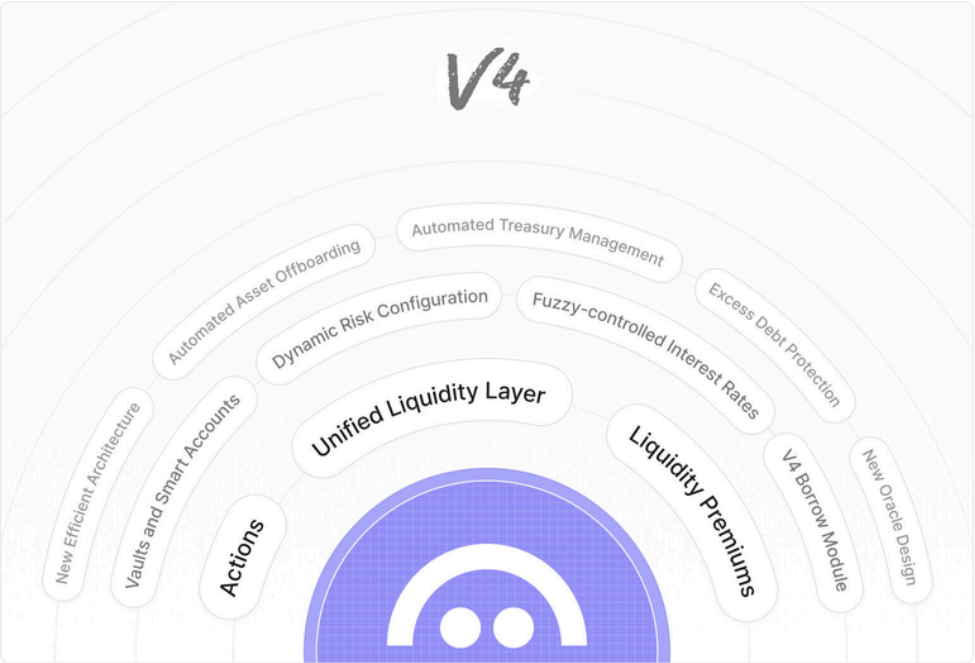
Finally, governance and continuous innovation—notably with the deployment of Umbrella, the AAVE token buyback program, the tokenization of real-world assets (Horizon), and the development of V4—reinforce Aave's credibility and competitiveness.
Beyond quantitative metrics, Aave also stands out for the quality of its execution and the strategic coherence of its developments. Each new feature—whether it is the introduction of the GHO stablecoin or the isolated mode to integrate new collateral—responds to a real market need and fits into a long-term vision. Where certain competitors launch experimental products or ones dependent on artificial incentives, Aave builds solid financial primitives, designed to last and adapt to the evolution of both crypto and institutional usage.
Finally, the open and modular nature of the protocol—reinforced by its active governance—makes Aave a high-value programmable backing infrastructure. Numerous DeFi protocols, as well as Web3 companies and RWA initiatives, rely on Aave as a liquidity layer or monetary back-end. In this respect, Aave does not merely dominate a market: it is becoming the technical foundation upon which a new financial system is being built. A finance whose foundations are still under construction, but of which Aave is already establishing itself as one of the essential architects.
GOVERNANCE AS A DRIVER OF INNOVATION
Aave is one of the rare protocols where community governance is not limited to a symbolic role. Since 2021, the Aave DAO has voted on dozens of decisive proposals: deployment on new chains, asset integration, risk parameter adjustments, tokenomics modifications, etc.
The AAVE token is at the center of this governance. Holding AAVE means holding a right of influence over the evolution of the infrastructure, with the possibility of voting on governance proposals or delegating one's voting power to the DAO's service providers.
But it is also gaining access to economic opportunities: staking in the Safety Module, which will soon make way for a Staking Module, allowing Aave stakers to benefit from a portion of the protocol's revenues.
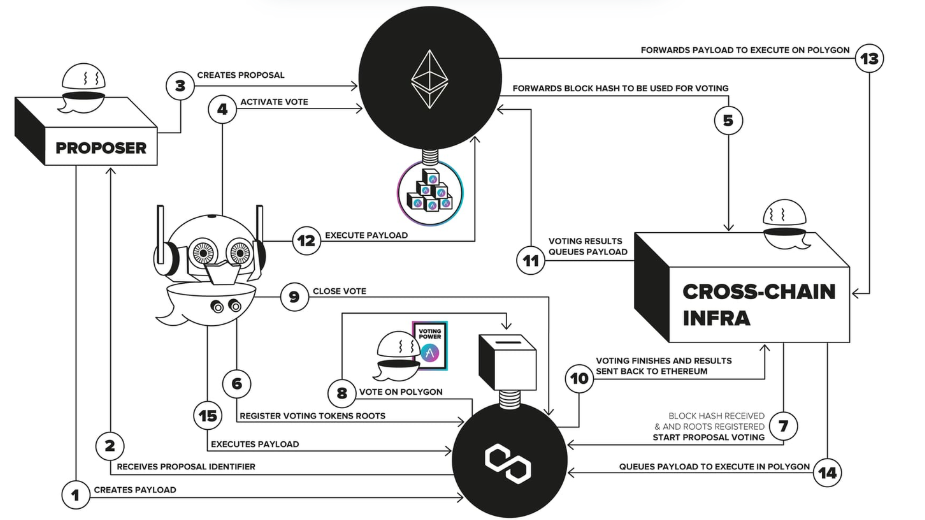
Among the most active service providers of the Aave DAO, Chaos Labs and Llamarisk play a central role in risk management by modeling collateral parameters and ensuring continuous monitoring of the protocol's economic health. TokenLogic is in charge of treasury management, with regular proposals on fund allocation, swap strategies, and now the implementation of the AAVE token buyback program.
For its part, the ACI (Aave Chan Initiative) acts as a strategic governance engine by structuring major proposals, such as the updating of Aavenomics, for example.
Together, these entities form a decentralized yet highly functional structure, halfway between a developer collective and an extended enterprise, capable of competing with the largest organizations in traditional finance.
GHO: A STRATEGIC TURNING POINT IN AAVE'S MODEL
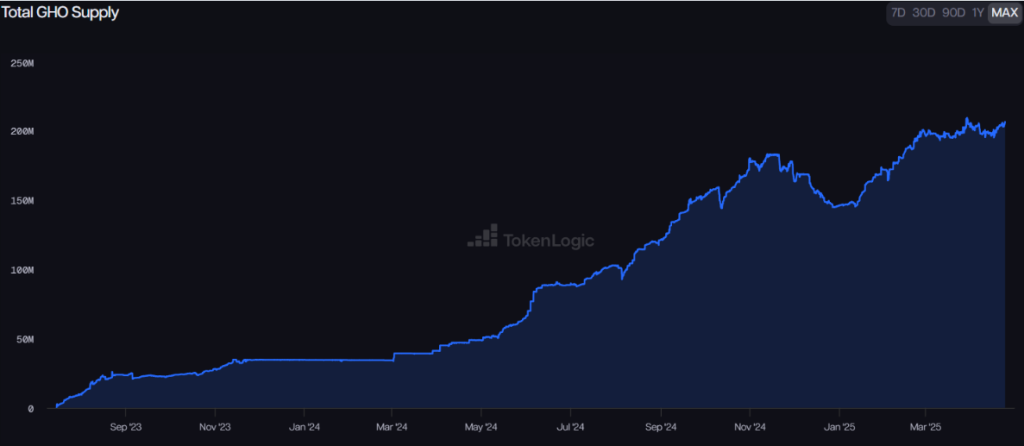
The launch of GHO in 2023 marked a major fork in the protocol's trajectory.
But the key innovation does not lie in the design of the stablecoin, which is already well charted. It lies in the value capture model. While Maker redistributes interest to its stakers, Aave redirects it entirely to the DAO. This detail changes everything: the interest paid by GHO borrowers becomes native revenue for Aave governance, which can do whatever it pleases with it: fund token buybacks, feed the treasury, subsidize integrations, or even fund incentives.
GHO is not just a simple functional extension. It is a powerful economic lever that allows Aave to add a monetary layer to its infrastructure. And this lever is still largely underutilized. In April 2025, GHO represents a supply of 200M$, a low figure compared to the total potential of DeFi. Its expansion to other blockchains (already on Polygon, Arbitrum, and Base), coupled with a more aggressive adoption strategy (integration into payments or Web3 applications like the on-chain social network Lens), could cause this metric to explode.
A MULTIPLE GROWTH TRAJECTORY: AAVE ASSAULTS GLOBAL FINANCE
If there is one thing that markets reward in the long run, it is the ability to grow beyond one's home market. And that is precisely what Aave is set to do: break out of the historical framework of DeFi to become a global monetary infrastructure, at the crossroads of three major trends — the tokenization of real-world assets (RWA), the evolution toward robust native economic security, and the unification of liquidity across blockchains.
Horizon: Aave opens up to institutions and tokenization
Project Horizon is likely the most ambitious strategic pivot undertaken by Aave since the launch of V3. Its premise: to enable regulated financial institutions to interact with Aave via a permissioned instance of the protocol, capable of hosting tokenized assets such as money market funds, credit, or even real estate.
This initiative responds to a clear need: RWA markets are exploding (+700 % in TVL over twelve months), but the Aave DAO captures only a marginal fraction of this value. Horizon proposes to fill this gap by combining DeFi infrastructure and regulatory requirements, via a shared revenue model (50/50) between Aave Labs and the DAO. This strategy would allow Aave to generate revenue uncorrelated with traditional crypto cycles, while strengthening the relevance of the GHO stablecoin within the ecosystem.
The most promising?
The ability for qualified institutions to borrow GHO against RWA collateral, thereby creating a structural bridge between traditional finance and the on-chain economy. As these use cases become normalized, Aave could become one of the major invisible players in global tokenization, capturing massive inflows of stable liquidity.
Umbrella: securing growth through native risk coverage
Final building block of this expansion: Aave Umbrella, a security system based on the staking of the aTokens themselves (such as aUSDC, aDAI, etc.). Unlike the traditional Safety Module where stakers risk their AAVE, Umbrella allows users to directly stake the tokens used as collateral in Aave. In the event of bad debt, the staked aTokens can be burned to cover the loss, in an automated and objective manner.
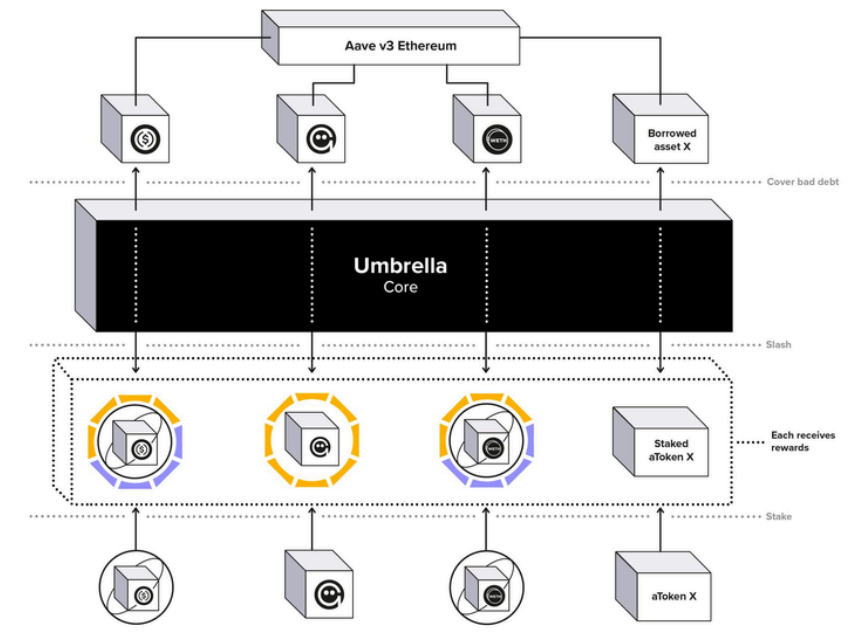
This mechanism changes everything:
- It removes selling pressure on the AAVE token in the event of slashing.
- It improves the protocol's solvency by aligning incentives with the reality of financial flows.
- It paves the way for large-scale, multi-chain coverage with dynamic rewards calibrated according to TVL and protection needs.
Umbrella, by enabling “native” risk coverage, thus strengthens Aave's legitimacy as a credible lending infrastructure in the eyes of institutions—a prerequisite for mass adoption.
Aave 2030: A technical roadmap for a decade ahead
At the same time, the Aave 2030 vision driven by Aave Labs proposes a major overhaul of the protocol around three key pillars:
- Aave V4, a new modular architecture with unified cross-chain liquidity management, native ZK-rollup support, and a streamlined governance system; ;
- The Cross-Chain Liquidity Layer (CCLL), designed to make Aave a “universal bridge” between blockchains, where a user can borrow on Arbitrum with collateral on Base or Ethereum without friction; ;
- The Aave Network, an in-house L2 (likely based on Validium or zkRollup) where GHO would be used as the fee token, AAVE as the staking asset, and unified governance for all instances.
These technical choices are not insignificant: they allow Aave to remain independent of the underlying blockchains while controlling its distribution, fees, and incentives.
It is a paradigm shift: Aave is no longer just a protocol integrated into Ethereum. It is becoming a sovereign infrastructure, capable of deploying, monetizing, and evolving according to its own rules.
A DISCIPLINED BUYBACK STRATEGY AND
STRUCTURALLY ALIGNED WITH VALUE CREATION
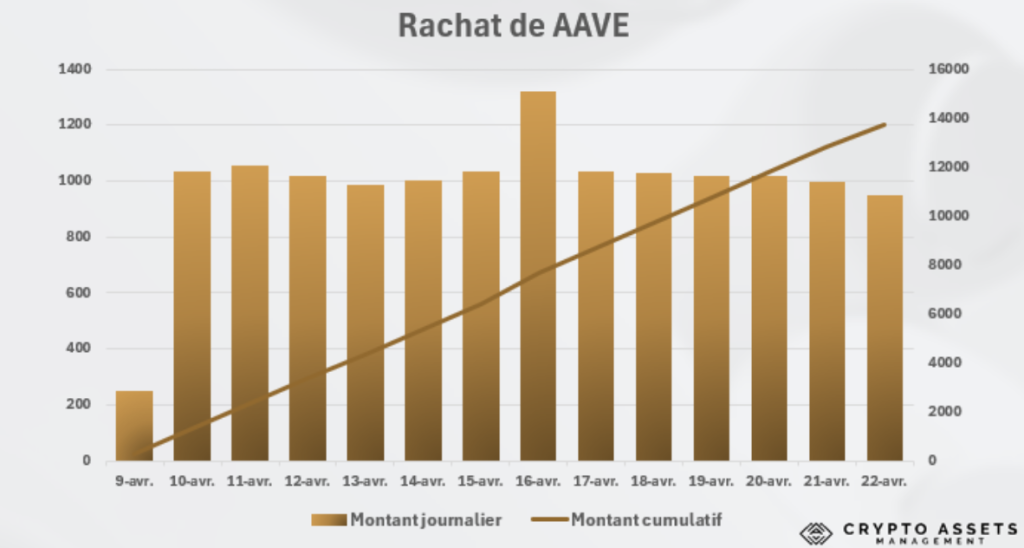
April 9, 2025, marks a turning point in Aave's financial governance with the official launch of its AAVE buyback and redistribution program, as part of the progressive implementation of the Aavenomics plan. This program is not limited to a symbolic token support operation — it embodies a coherent macroeconomic strategy to recycle the protocol's surplus revenues for the benefit of token holders.
A structural program backed by real surpluses
In the span of just ten days, 11,285 AAVE were repurchased at an average value of 139.25 $, representing an investment of over 1.57 million dollars, funded in stablecoins via the protocol's reserves. This pace matches exactly the budget voted on in governance: 1 million dollars per week for six months, meaning an estimated budget of 26 million dollars for this first cycle.
Unlike the majority of buyback programs observed in DeFi, Aave's is neither one-off nor even “opportunistic” (tied to a price drop). It is designed as a systemic and sustainable mechanism, scaled according to the protocol's actual budget, with strict safety margins.. The newly mandated finance committee (AFC) adjusts allocations monthly based on the assets available in the treasury, with purchases potentially entrusted to third-party market makers.
Beyond its accounting impact, this buyback program reflects a fundamental evolution in how the DAO manages its surpluses: shift from a logic of passive accumulation to a logic of active valorization of the AAVE token. By redirecting a portion of its revenues to the secondary market, Aave is introducing a regular price support mechanism while enhancing the perceived value for its stakers. This policy also helps to further align the interests of protocol users, token holders, and governance by establishing a virtuous circle of value creation based on organic growth rather than dilution.
Efficiency already visible, despite neutral conditions
From a strictly financial perspective, as of April 20 the program showed a slightly negative performance (–9,200 $, or –0.59 %), reflecting an average purchase price slightly higher than the current market price. But that does not matter: the goal is not short-term speculative profit. What this operation truly achieves is:
- Reduce AAVE's circulating supply by transferring the purchased tokens to the ecosystem reserve. If the average purchase price remains around 140 $, over 350,000 AAVE could be repurchased over one year, representing approximately 2.2 % of the current supply.
- Redistribute the repurchased AAVE to protocol stakers, who are now freed from their coverage role thanks to the implementation of Umbrella.
This choice prioritizes rewarding long-term aligned holders, rather than proceeding with a burn that would indiscriminately benefit all holders, including those who speculate or do not actively participate.
Redistribution thus targets those who truly support the ecosystem, reinforcing engagement and loyalty around the protocol.
CONCLUSION
At Crypto Asset Management, we believe that Aave is one of the most undervalued protocols in terms of fundamentals in the crypto universe. While the market has often favored the novelty effect or artificially boosted yields, Aave has pursued a clear course: that of robustness, economic sustainability, and the construction of sustainable infrastructure.
Combining a dominant position in lending, a clear vision around the GHO stablecoin, strategic initiatives in tokenization (Horizon), security (Umbrella), and governance (Aavenomics), the protocol is building a comprehensive financial architecture that anticipates the needs of both retail and institutional users.
The AAVE token embodies this vision: not only a governance tool, but also and above all a share in the capital of a platform that is organically growing, well-funded, and capable of redistributing its revenues to its aligned holders.
In an ecosystem striving for quality and long-term sustainability, we see AAVE as a strategic asset for any investor looking to gain exposure to the backbone of tomorrow's DeFi.
If you would like to download the report as a PDF:
Author's note :
My name is LittleGhost. I spend my days studying DeFi, reading governance proposals, and figuring out how to build something truly sustainable in this booming ecosystem.
If you would like to continue following my work:
📺 YouTube : LittleGhost
🐦 Twitter/X : @0xLittleGhost
Thank you sincerely for taking the time to read this report, and see you very soon for new analyses.
Our service
At Crypto Assets Management, we offer discretionary portfolio management of digital assets, tailored to your profile. Our strategy is based on the analysis and management of Bitcoin cycles (historically 4 years), favoring investments in long term, monthly arbitrations, and a particular emphasis on tokenomics.
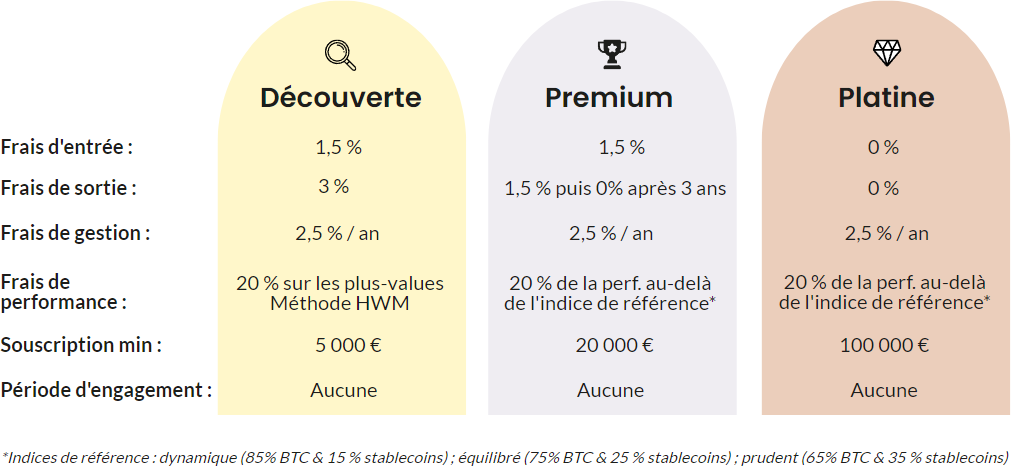
Our Rates

We are saved with the AMF under the registration number for digital asset buy/sell activities against legal tender and digital asset exchange against other digital assets: E2023-084.
— Warning —
This letter is not investment advice.
You are solely responsible for your investment decisions.
Investing in digital assets carries a risk of capital loss, partial or total.