



The objective of this letter: «Cautious repositioning; altcoin capitulation; Bitcoin ETF accumulation» is to inform you about the current crypto-asset market situation as well as recent news in this field. This letter is not investment advice, but merely a sharing of my personal viewpoint.
News
After stablecoins and the crypto market, the United States is going to tackle the tokenization issue. While the proposed CLARITY Act crypto legislation is still facing numerous divisions, French Hill, the chairman of the influential House Financial Services Committee, has announced the United States« »next major priority" in terms of regulation. This involves the tokenization project, in order to determine whether legislative or simply regulatory intervention is needed.
–
CLARITY Act: «The government must act with caution». For months, the U.S. crypto market legislation project, the CLARITY Act, has been facing a true roadblock from U.S. banks on the issue of applicable yields for stablecoins, which must not compete with bank deposits, and even the recent achievement of a compromise does not seem to truly unblock the situation.
–
The CFTC clarifies the rules of the game for crypto perpetuals: Kalshi and Coinbase capitalize on it. While the CFTC has approved a Kalshi Bitcoin perpetual contract and clarified its regulatory framework, new doors are opening for crypto derivatives trading. What is the status of this?
–
Sluggish growth – Is France on the verge of recession? Falling GDP, rising inflation and slowing consumption... France has been fearing a recession since the publication of uninspiring economic indicators by Insee. But Roland Lescure, the Minister for the Economy, claims he does not want to give in to alarmism.
–
«Holding your own bitcoins is not suspicious behavior»: INBi steps up to the plate on data collection. While regulators are imposing ever more data collection, INBi is publishing a research note to oppose it. What is this all about?
–
Hyperliquid: US exchanges want to regulate this terrifying new player. While trading volumes on the Hyperliquid platform continue to grow and exceed cryptocurrency-related assets, some traditional exchanges are becoming concerned and calling for more regulation.
Fundamental Analysis
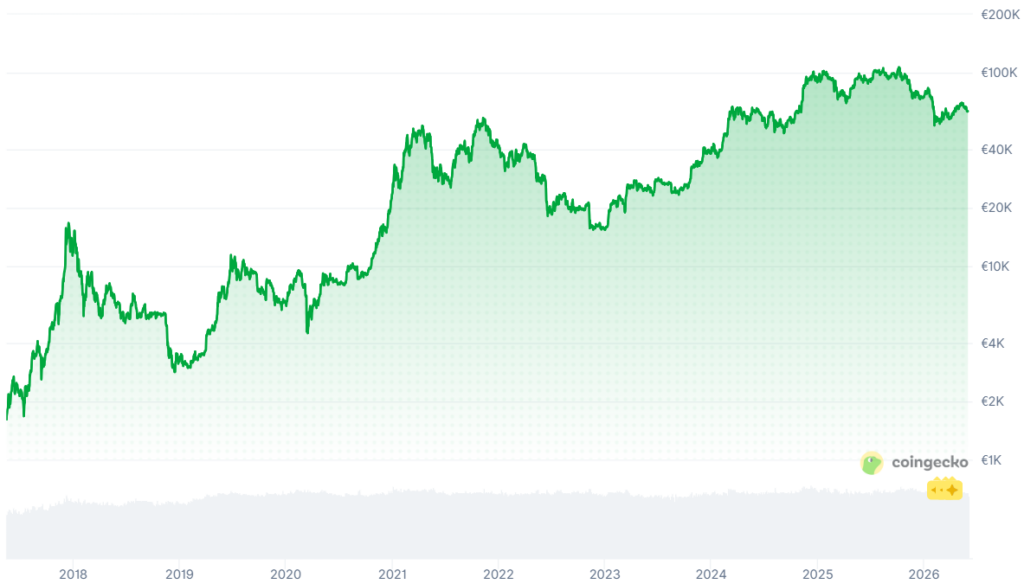
Letter No. 51: Cautious repositioning; altcoin capitulation; Bitcoin ETF accumulation
The price of Bitcoin at the time of writing this letter is 73,000 $ (05/31/2026).
A cautious repositioning within the bear market
In a bear market context marked by low liquidity and persistent geopolitical uncertainties, many investors, particularly institutional ones, currently maintain a cautious approach.
On-chain data shows that investors who recently entered the market acquired their bitcoins at an average price between $75,000 and $78,000. This concentration of purchases at these levels reflects a certain confidence in Bitcoin's long-term potential.
However, this cohort also remains one of the most sensitive to price variations. In the event of insufficient demand or an external shock leading to another market decline, these investors could be among the first to reduce their exposure, thereby temporarily increasing selling pressure.
The graph below makes it possible to assess this risk by comparing the price of Bitcoin with the main acquisition costs of the different categories of investors.
- Bitcoin price (black): market price of Bitcoin.
- STH Realized Price (red): average purchase price of short-term investors (less than 155 days), generally the most reactive to market fluctuations.
- True Market Mean (vert) : estimation of the average market cost after adjusting for bitcoins considered lost or inactive for a very long time.
- Realized Price (blue): average acquisition cost of all currently circulating bitcoins.
What this means:
- When the Bitcoin price trades above the STH Realized Price (red), recent investors are generally in profit, which typically favors the continuation of an uptrend.
- When the price falls below this level, these investors enter an unrealized loss, increasing the risk of sales driven by fear or the need to limit losses.
- The areas close to the True Market Mean (green) have historically constituted attractive accumulation zones during bear markets.
- A return to the Realized Price (blue) generally corresponds to the most advanced capitulation phases of a cycle.
The longer the Bitcoin price stays above these various acquisition costs, the more solid the market structure remains. Conversely, when the price approaches or drops below them, the risk of selling pressure gradually increases.
At this stage, the chart suggests that the market has probably not yet reached its true turning point. Historically, the latter occurs when the acquisition cost of recent investors (red) reaches or gets very close to the average cost of the entire market (blue).
This does not necessarily mean that Bitcoin has to experience another sharp decline. The low point of the cycle may have already been reached in terms of price, with a range between $55,000 and $65,000 that corresponds to a consistent level compared to previous corrections.
On the other hand, the market may need more time to rebuild. In other words, even if the price bottom is potentially behind us, the duration bottom may not be yet. In this scenario, Bitcoin could trade in a relatively flat phase over the coming months, possibly until September or October 2026, before a new bullish momentum takes hold once the red and blue curves have converged or come very close together.
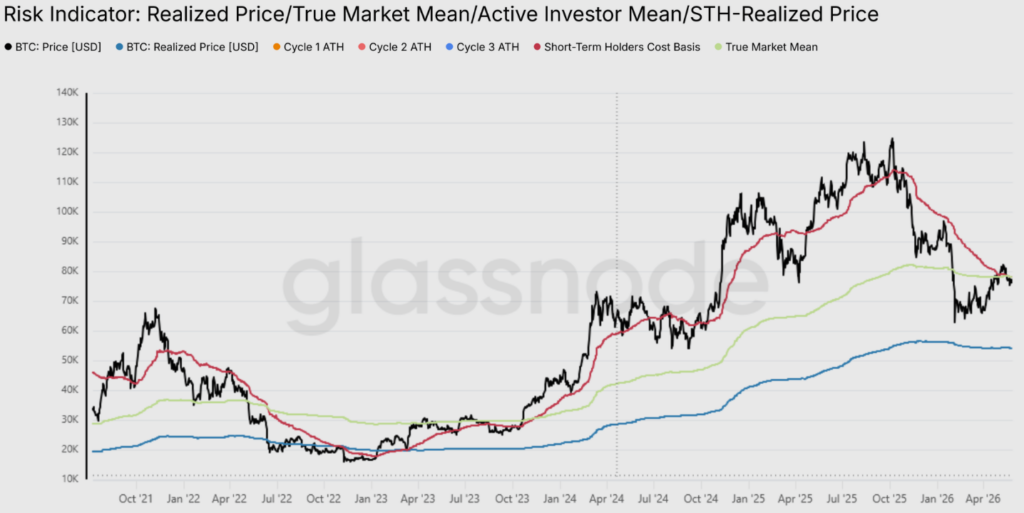
Comparison of the Bitcoin price with the main investor cost bases. – Glassnode
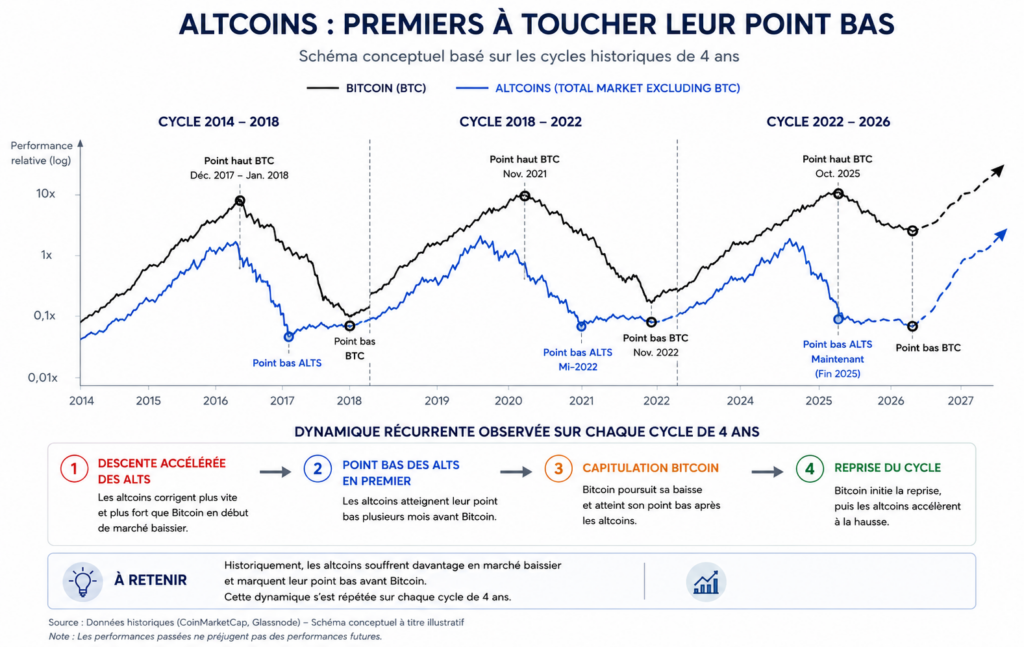
Altcoins historically hit their bottom before Bitcoin during bear markets
In the crypto-asset ecosystem, not all tokens react in the same way to market cycles. Although Bitcoin remains the sector's benchmark asset, altcoins generally exhibit higher volatility as well as increased sensitivity to liquidity variations and investor sentiment.
During advanced bear market phases like the one we are currently experiencing, this difference in behavior becomes particularly visible. Altcoins often record larger corrections than Bitcoin because they are considered riskier assets. When financial conditions deteriorate and investors seek to reduce their risk exposure, capital tends to leave the most volatile assets first.
This dynamic generally leads to a faster and more pronounced drop in altcoins during the first part of the bear market. Historically, many quality altcoins thus reach their bottom first, before Bitcoin. Once this capitulation phase is over, their price often moves in a relatively stable and flat range while Bitcoin sometimes continues its consolidation phase. Then, they do not leave again until Bitcoin gives the bullish signal.
This difference is notably explained by the market structure. Altcoins generally have a lower capitalization and more limited liquidity than Bitcoin. Selling flows therefore have a proportionally greater impact on their price. Conversely, when confidence gradually returns to the market, investors tend to return to Bitcoin first before gradually repositioning themselves in altcoins.
Bitcoin ETFs continue their quiet accumulation
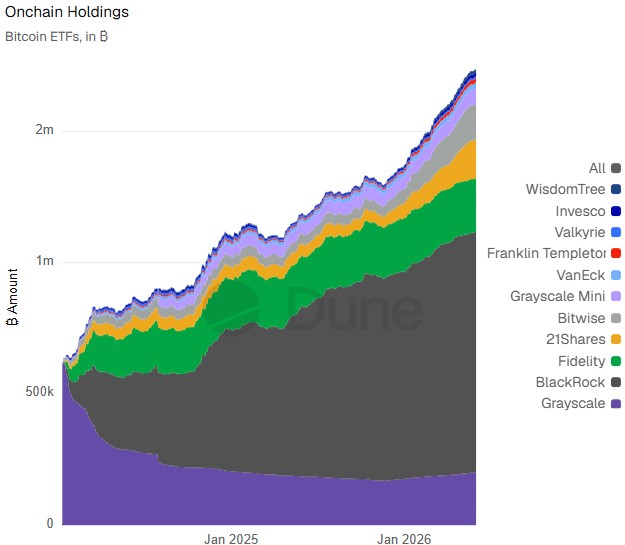
US spot Bitcoin ETFs are now one of the most powerful investment channels for capturing institutional demand. Since their launch in January 2024, the amount of Bitcoin held by these regulated investment vehicles, integrated into traditional finance infrastructure, has continued to increase.
On a daily basis, inflow and outflow trends can sometimes give the impression of a hesitant market. Yet, when taking a step back and looking at the trend over several months, the conclusion is clear: ETFs continue to accumulate Bitcoin at a steady pace.
As we discussed in a previous letter, this bear market represents an opportunity for institutional investors. Unlike previous cycles, these players arrived after retail investors. This bear market phase therefore allows them to gradually catch up and absorb a growing share of the available supply.
When spot ETFs launched in January 2024, the bitcoins already held by Grayscale Investments' fund and converted into an ETF represented about 2.95 % of the total Bitcoin supply. Today, all US spot ETFs hold nearly 6.37 % of all circulating bitcoins.
If we take into account the bitcoins assumed to be permanently lost and assume a truly available supply estimated at around 17.5 million bitcoins, so US spot ETFs now account for nearly 7.64 % of the effective available supply. This proportion is considerable for an asset class whose supply is strictly limited to 21 million units.
This momentum could continue over the coming years. ETFs indeed make it easier to access Bitcoin for a wide range of investors who would never have bought crypto assets directly. Part of this exposure can now be obtained indirectly via retirement accounts, life insurance contracts, pension funds, sovereign wealth funds, or even certain government reserves.
As Bitcoin is progressively integrated into the strategic allocations of major financial institutions, a growing share of the available supply could be absorbed by investors with a long-term investment horizon. This evolution reinforces the idea that Bitcoin is no longer just a speculative asset, but is gradually becoming a full-fledged component of the global financial system.
Our service
At Crypto Assets Management, we offer discretionary portfolio management of digital assets, tailored to your profile. Our strategy is based on the analysis and management of Bitcoin cycles (historically 4 years), favoring investments in long term, monthly arbitrations, and a particular emphasis on tokenomics.
Our Rates

Mereau Finance (Crypto Assets Management) is registered as a Digital Asset Service Provider (DASP) with the Autorité des marchés financiers (AMF) under the number : E2023-084.
— Warning —
This letter is not investment advice.
You are solely responsible for your investment decisions.
Investing in digital assets carries a risk of capital loss, partial or total.