



Hello everyone,
The purpose of this letter is to inform you about the current situation of the crypto-asset market as well as recent news in this field. This letter is not investment advice, but merely a sharing of my personal point of view.
News
$2 billion recently invested by institutional investors: Crypto investment products targeted at professional and institutional investors have seen a clearly positive influx of money in recent weeks. Cryptocurrencies are becoming essential for any asset manager worth their salt. The latest data from CoinShares thus confirms that institutional investors are in high demand for crypto-assets, and particularly Bitcoin (BTC).
–
Bitcoin: El Salvador gets approval to issue the first BTC-backed bond. El Salvador has obtained approval to issue Bitcoin (BTC)-backed bonds through Bitfinex Securities, scheduled for the first quarter of 2024. This initiative, dubbed «Volcano bonds,» was approved by the National Commission of Digital Assets (CNAD) two years after Nayib Bukele first spoke about them.
–
Will Ether (ETH) outperform Bitcoin (BTC) in 2024? Yes, according to JPMorgan. Ethereum's ETH could be the big winner of 2024, according to JPMorgan. Analysts indeed believe that the second-largest cryptocurrency will outperform the queen of cryptocurrencies. What are they projecting?
–
13 years ago, Satoshi Nakamoto published a final post on Bitcoin Talk. 13 years ago, Satoshi Nakamoto published a final message on the Bitcoin Talk forum before disappearing a few months later. Let's look back at these events that keep the mystery alive around the creation of Bitcoin (BTC).
–
BlackRock revises its spot Bitcoin ETF to facilitate cooperation with banks. The involvement of banks in the issuance of Spot Bitcoin ETFs, a recent initiative by BlackRock, represents a crucial step in bringing traditional financial institutions closer to the cryptocurrency universe. This move could not only facilitate the entry of institutional capital into this sector, but also redefine how cryptocurrencies are perceived and managed within the global financial system.
–
France: your bank will cost you 31 to 255 euros more in 2024. Bank fees are increasing in 2024, and certain actions will now cost customers more. Which banks are impacted, and how much will individuals have to pay?
–
US Inflation: The CPI (Consumer Price Index) has just been released, and it is positive for Bitcoin. Among the bullish factors for the cryptocurrency market in 2024, people often talk about the approval of a spot BTC ETF, or the process of halving which will further make the issuance of new bitcoins scarcer. But the monetary policy of the United States, and of its central bank (the Fed), probably has an even greater role to play. This policy closely monitors US inflation (CPI index) to determine the course of action: an increase, stagnation, or decrease for the Fed's key interest rates?
–
El Salvador offers a $1 million freedom visa in partnership with Tether – What is it all about?. El Salvador is launching its «Freedom» visa program, offering citizenship in exchange for a $1 million investment in Bitcoin or USDT. Developed in partnership with Tether, this ambitious initiative could generate up to $1 billion for the Central American country, while contributing to its economic and social development.
Fundamental Analysis
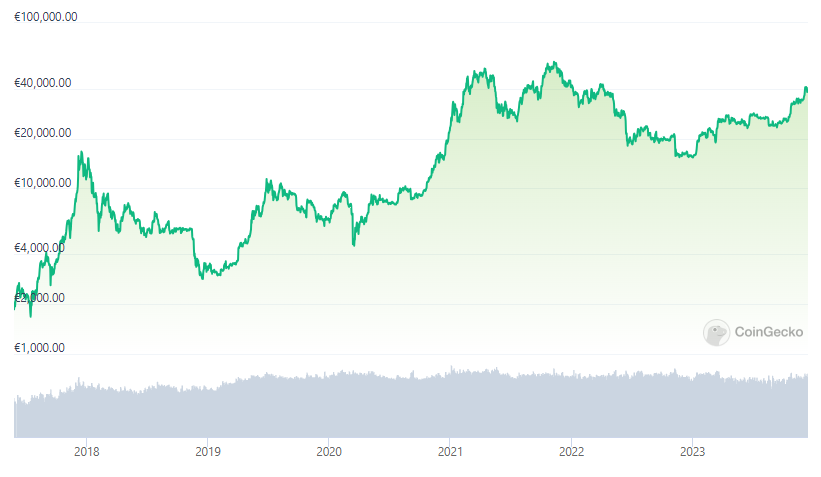
Source : https://www.coingecko.com/fr
At the time of writing, the price of Bitcoin is 43,143 $ (as of 12/14/23).
A new channel allowing traditional capital to flow into Bitcoin:
Spot Bitcoin ETFs are exchange-traded funds that allow investors, primarily institutional ones, to acquire shares representing ownership of Bitcoins without needing to physically hold the digital asset via a secure wallet. The term «spot» implies that the institutions offering these ETFs actually hold the underlying Bitcoins.
These ETFs reflect the price of Bitcoin and provide a more accessible and regulated way to invest in the asset in question.
Institutional adoption has accelerated sharply in recent months. We can observe the imminent approval spot Bitcoin ETFs sponsored pair of big names in traditional finance, such as BlackRock, Fidelity, or Bitwise.
Just like with the first international gold ETF in 2003 and the first US gold ETF in 2004, this opens a new channel allowing traditional capital to flow in toward «digital gold».
The worst year on record for US bond investors:
According to an analysis by Edward McQuarrie, professor emeritus at Santa Clara University who studies historical investment returns:
«Even if we go back 250 years, we cannot find a worse year than 2022.»
The resilience of blockchain in the face of a terrible macro market for risk assets and historic catastrophes is impressive... The price of Bitcoin fell in line with tech companies last year. This year, it has largely outperformed most of those companies:
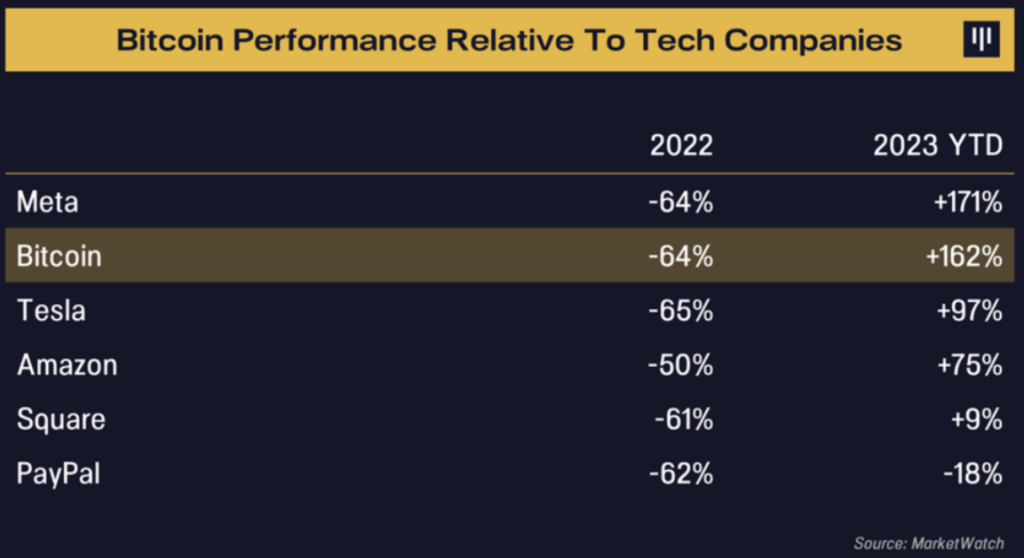
Pantera Capital
Where are we in the cycle?
As the price of Bitcoin approaches a new cycle peak, there is a notable reduction in the percentage of coins held for more than a year. This trend is partly attributed to the holders of these coins choosing to realize profits by selling, which means these coins are no longer classified in the 1 year+ category in this analysis.
So, in a bull market, the 1-year HODL wave, represented by the orange line, decreases while the price, represented by the black line, increases. We can clearly see 4 major waves (downward) on the orange curve. These are selling waves when we are in a bull market.
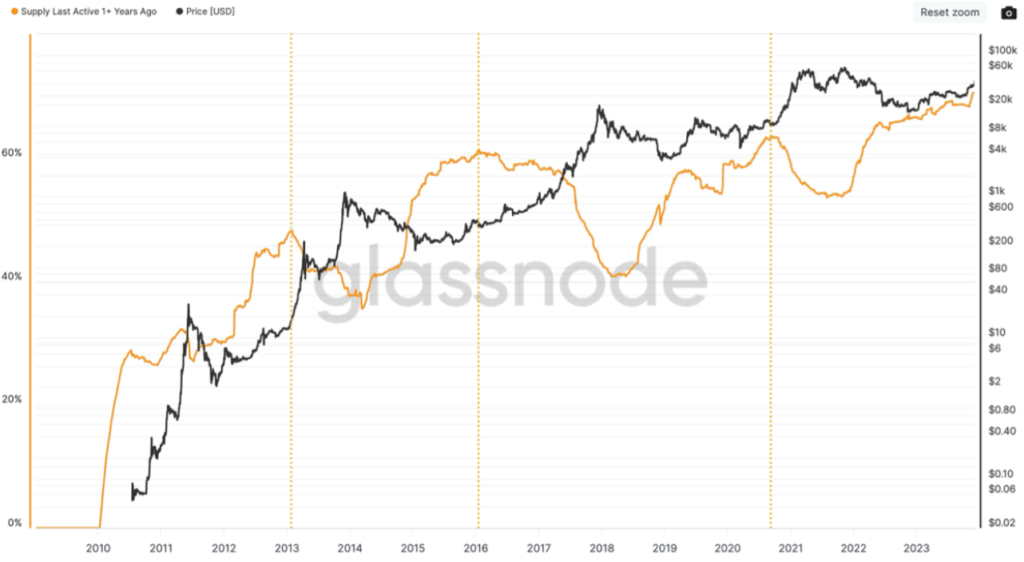
Glassnode
Historically, the Bitcoin price increased slowly and steadily up to the indicator peaks (in orange). After a peak and a reversal, the price increased rapidly and sharply, with these surges lasting an average of 1.3 years between the indicator peak and the price peak. Here are the returns before the peaks of the orange indicator and what happened subsequently to the Bitcoin price:
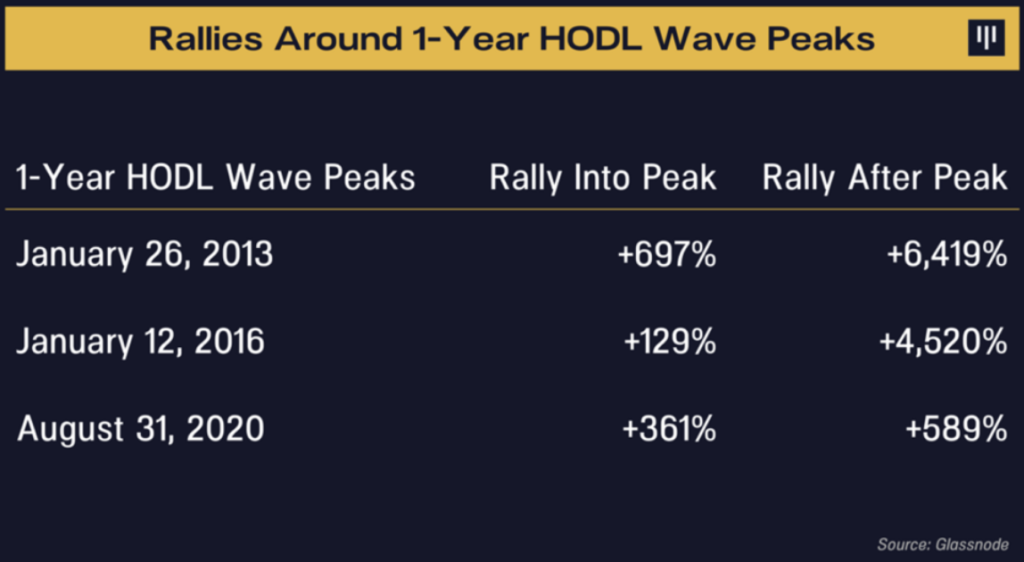
Pantera Capital
This means that in terms of time, we are probably halfway through the cycle, as we wrote last month in our letter: Letter No. 31: Halfway between capitulation and euphoria; The mirage of fiat currency.
However, we are probably not halfway to the next price peak, as we can see in the chart above from Pantera Capital.Historically, compared to previous cycles, the majority of this cycle's gains are still to come.
The progression toward high-speed internet thanks to layer 2:
First of all, a quick reminder of the difference between a Layer 1 and a Layer 2 blockchain:
- Layer 1 It is the foundational layer of the blockchain, where block creation and validation take place. Layer 1 blockchains include networks like Bitcoin and Ethereum. They are responsible for the security and validity of transactions, and every transaction is recorded on the main blockchain.
- Layer 2 This is a solution that relies on an existing Layer 1 blockchain to improve its performance and scalability. They aim to offload some of the traffic from the main blockchain, which helps increase transaction speed, reduce fees, and introduce new features without requiring fundamental changes to the Layer 1 protocol. These solutions can process transactions off the main chain and only submit the final results to the main network for validation.
In summary, the major difference between the two is that Layer 1s constitute the main foundation of the blockchain where transactions are confirmed and added to the chain, whereas Layer 2s offer solutions to improve the performance and scalability of Layer 1s without directly altering the main protocol.
We believe the competition for Layer 1 is already over, with Ethereum as the winner. To maintain its position, Ethereum must now focus on scaling, presumably through multiple Layer 2 solutions built on top. Here is how Ethereum currently dominates the Layer 1 battle, illustrated by its market share in Total Value Locked (TVL).
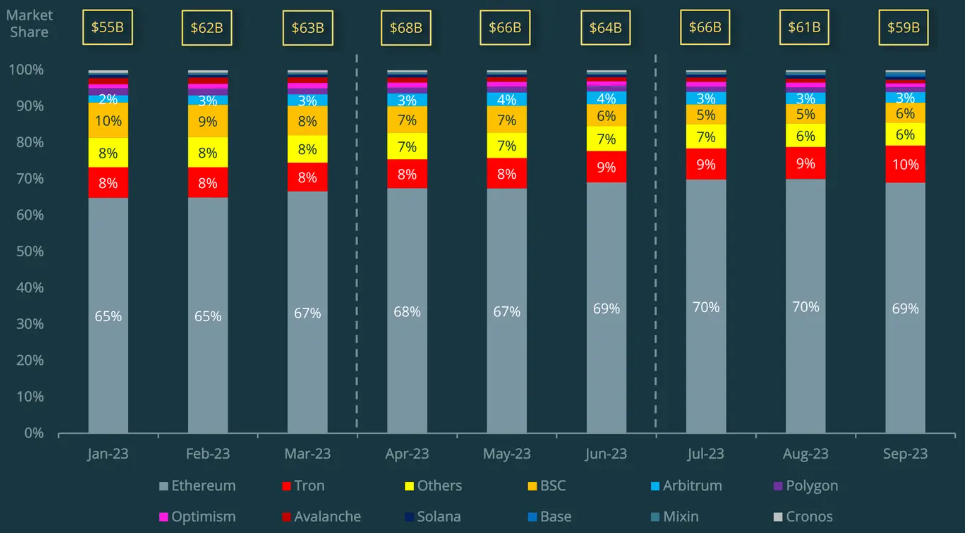
Coingecko
We anticipate that the next battle will take place within Layer 2s. Total value locked is steadily increasing, and market shares are likely to fluctuate considerably depending on the evolution of projects and proposed solutions. The ultimate goal, with a Layer 1 such as Ethereum and several adjacent Layer 2s, is to achieve a system capable of processing a high volume of transactions while guaranteeing robust security and maximum decentralization.
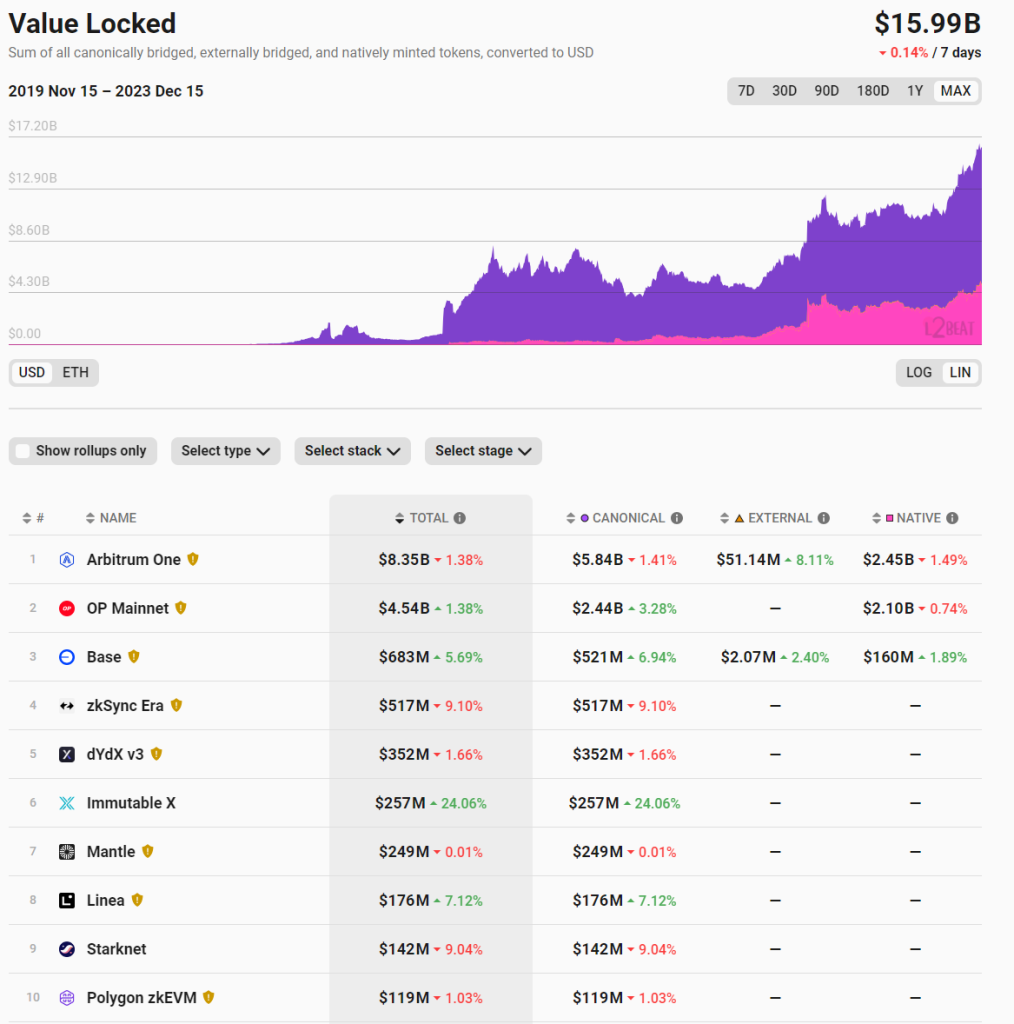
Coingecko
Within these Layer 2s, there are two major categories that will likely clash: the Optimistic Rollups and ZK-Rollups. The latter two are scaling techniques used in Layer 2 blockchains to improve performance.
- ZK-Rollups (Zero-Knowledge Rollups) These are scaling solutions that use cryptographic proofs called zero-knowledge proofs to aggregate and verify a large number of transactions off the main blockchain. These proofs make it possible to confirm the validity of transactions without revealing the specific details of the transactions themselves, thereby ensuring data privacy while reducing the load on the main chain.
For example, if we want to prove our majority without revealing our exact age, we show our driver's license and this confirms our adult status without communicating our exact age to our interlocutor. This is somewhat the same principle that ZK-Rollups use.
- Optimistic Rollups These solutions rely on a different approach where transactions are initially processed off the main chain and then submitted to the main layer for verification. Unlike ZK-Rollups, which use cryptographic proofs for verification, Optimistic Rollups assume that transactions are valid by default (hence the term «optimistic»). Transactions are grouped and submitted to the main chain to be verified only if a dispute arises. This helps reduce the load on the main chain by processing most transactions outside of it.
These advancements toward scaling solutions represent a major pivot in the quest for increased performance and a more scalable and secure blockchain infrastructure. May the best projects win!
Is France in a debt trap?
We are probably, in France, in a debt trap. It is an undesirable situation.
A «debt trap» is an economic situation in which a country or entity finds itself trapped in a vicious cycle of excessive debt, which is often difficult to resolve. This situation is characterized by several aspects:
- Excessive debt: This occurs when the debt accumulated by a government, a business, or an individual becomes unsustainable relative to their ability to repay it.
- Borrowing-repayment cycle: The indebted entity continues to borrow to repay the interest on existing debt or to pay maturing obligations, which further increases its overall debt.
- Increased reliance on loans: The debt trap can make an entity increasingly dependent on loans to finance its current operations, thereby exacerbating the problem.
- Risk of financial crisis: If debt becomes unsustainable, it can lead to a major financial crisis, affecting not only the indebted entity, but also other stakeholders such as creditors, financial markets, and even other economies.
In short, a debt trap represents a vicious cycle where excessive debt hinders economic growth, investment opportunities, and limits options to escape this financial spiral.
This can be seen in the diagram below: when the black curve, illustrating debt service as a percentage of GDP (debt interest), exceeds the purple curve, which represents the growth rate, total debt increases. With this rise in total debt, debt service also grows, thus creating a self-amplifying loop.
To picture the situation: Imagine you earn nothing each month, but you have to pay €2,000 in loan interest. To pay them, you take out new loans. It is a vicious circle that only deepens and leads to bankruptcy.
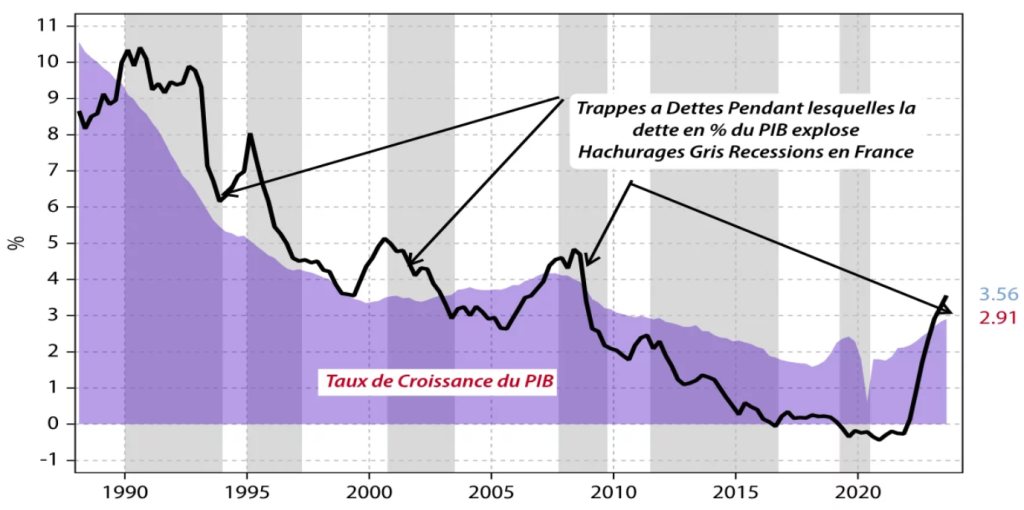
the Institute of Liberties
Four ways out of this situation: two ways to raise the purple curve and two ways to lower the black curve, knowing that what must not happen is for the black one to rise above the purple one:
- A sharp increase in economic growth, a major or even nearly impossible challenge in our Western economies, which are already highly developed and facing an aging population.
- A sharp reduction in the standard of living and therefore public spending, as well as a considerable increase in taxes to boost tax revenues.
- The ECB (European Central Bank) could opt for substantial and regular printing of euros, resulting in a currency depreciation and thus an indirect reduction of debt denominated in euros. Undesirable side effect: inflation.
- A sharp drop in interest rates (which could be considered), even though this would only postpone the problem to the future, knowing that we have already been kicking this can down the road for some twenty years. Side effect: inflation.
We consider two of the «solutions» or «loopholes» mentioned above to be more feasible: numbers 2 and 3, namely a reduction in public spending accompanied by an increase in taxes for French citizens, alongside a money-printing policy by the ECB in order to decrease the value of the euro and cover the accumulated debts, even if this risks generating long-term inflation.
The bad news for French citizens, who are probably already feeling it, translates into a reduction in public services, an increase in expenses and, consequently, a weakening of the standard of living.
In conclusion, to end on a more positive note, the accessible solutions as a citizen are as follows:
- Limit exposure to the euro to avoid a devaluation
- Limit exposure to French real estate, which is likely to experience a significant tax increase, as it is an investment that is difficult to relocate and therefore a prime target for the state to increase its tax revenues.
- Prevent too large an accumulation of bank deposits.
- Limit the holding of French bonds.
- Prioritize actions disconnected from the State, such as Air Liquide or LVMH, unlike EDF, because their value is independent of the currency or the country where they are listed.
- Favor exposure to gold, which has been the benchmark store of value for centuries.
- Prioritize exposure to crypto-assets, or at least to Bitcoin, which is a long-term store of value.
Our service
We offer a discretionary portfolio management service specializing in digital assets. We provide comprehensive, end-to-end human support in this space by personalizing your portfolio allocation according to your risk profile and situation.
With our turnkey management approach, you can take advantage of industry trends without worrying about digital asset selection, in-depth token research, volatility, arbitrage, and more. You simply need to review your monthly reports and invest regularly, adopting a long-term perspective (4 years and more).
We do not engage in daily algorithmic trading; we focus exclusively on long-term investments in projects we know and understand. Our monthly portfolio rebalancing is accompanied by an in-depth analysis of the assets, with a particular focus on their tokenomics.
Check out our website: https://www.mereau-finance.com/
For any questions, observations, or if you would like to learn more about our services, please feel free to contact us by email at tristan.g@crypto-assets-management.com or to schedule a brief phone call afterwards this link.
Discovery Pack
Investment of under €20,000
- No admission fee
- Management fees: 2 % / year
- Performance fee: 20 % excl. VAT on capital gains (High Water Mark method)
- Exit fee: 3 %
- Minimum subscription: €5,000
- Commitment period: None
Premium Pack
Investment of more than €20,000
- No admission fee
- Management fees: 2 % / year
- Performance fee: 20 % of the performance above the benchmark index*
- Exit fees: None
- Minimum subscription: €20,000
- Commitment period: None

We are saved with the AMF under the registration number for digital asset buy/sell activities against legal tender and digital asset exchange against other digital assets: E2023-084.
— Warning —
This is not investment advice, no one can predict the future.
You are solely responsible for your investment decisions.
We are not responsible for losses following a decision made on the basis of the information in