



Hello everyone,
The purpose of this letter is to inform you about the current situation of the crypto-asset market, as well as recent news in this field. This letter is not investment advice, but merely a sharing of my personal point of view.
News
On Monday, March 14, the European MiCA (Markets in Crypto-Assets) regulation was voted on. An «article» in this law almost got adopted and has been the subject of much attention. This article discussed a possible ban on Bitcoin mining and other crypto-assets with the same security system in Europe.
The crypto community has made a lot of noise in recent days against this potential ban on mining (via proof of work) in Europe. Many voices have been raised.
As it stood, this article was a death sentence for the future of crypto-assets in Europe. By banning European companies from providing Bitcoin and Ethereum exchange services, and by complicating the use of NFTs and DeFi, the European Parliament came dangerously close to shooting itself in the foot regarding our monetary and financial sovereignty.
This article was a significant departure from the principle of technological neutrality. This would have led to deadly regulation that would have excluded Bitcoin and Ether from the services these companies provide in Europe.
Why attempt to ban the security protocol of a vast majority of crypto-assets, including Bitcoin and Ethereum? According to Alexandre Stachtchenko (co-founder of Blockchain Partner and the ADAN association), the European elite reportedly used the following as a source to draft this article: a simple blog written by a young banker with no technical background who readily admits he created his website as a hobby. Here is the link to the thread on Twitter.
Whether it is DeFi or NFTs, these technologies are still at an early stage of development. It is the future use cases that we will need to regulate, not the technology. Parliament is transposing old global financial regulation into a structurally different new technology.
MEPs have adopted a hard line on crypto-assets, believing that they are protecting citizens. In reality, this version is stultifying for our competitiveness while, at the same time, President Biden signed a law calling on the United States to fully embrace this new ecosystem.
Once again, we almost left opportunities to others while boasting about having good regulation. If this text had been adopted as is, we would have paid the price in terms of competitiveness and the interests of European citizens.
By chance, this article was narrowly rejected. Unfortunately, the regulatory battle is far from over, and stakeholders will still need to demonstrate educational outreach to Europe to enable the development of a healthy framework.
If you would like to know more about the MiCA regulation: Click here.
—
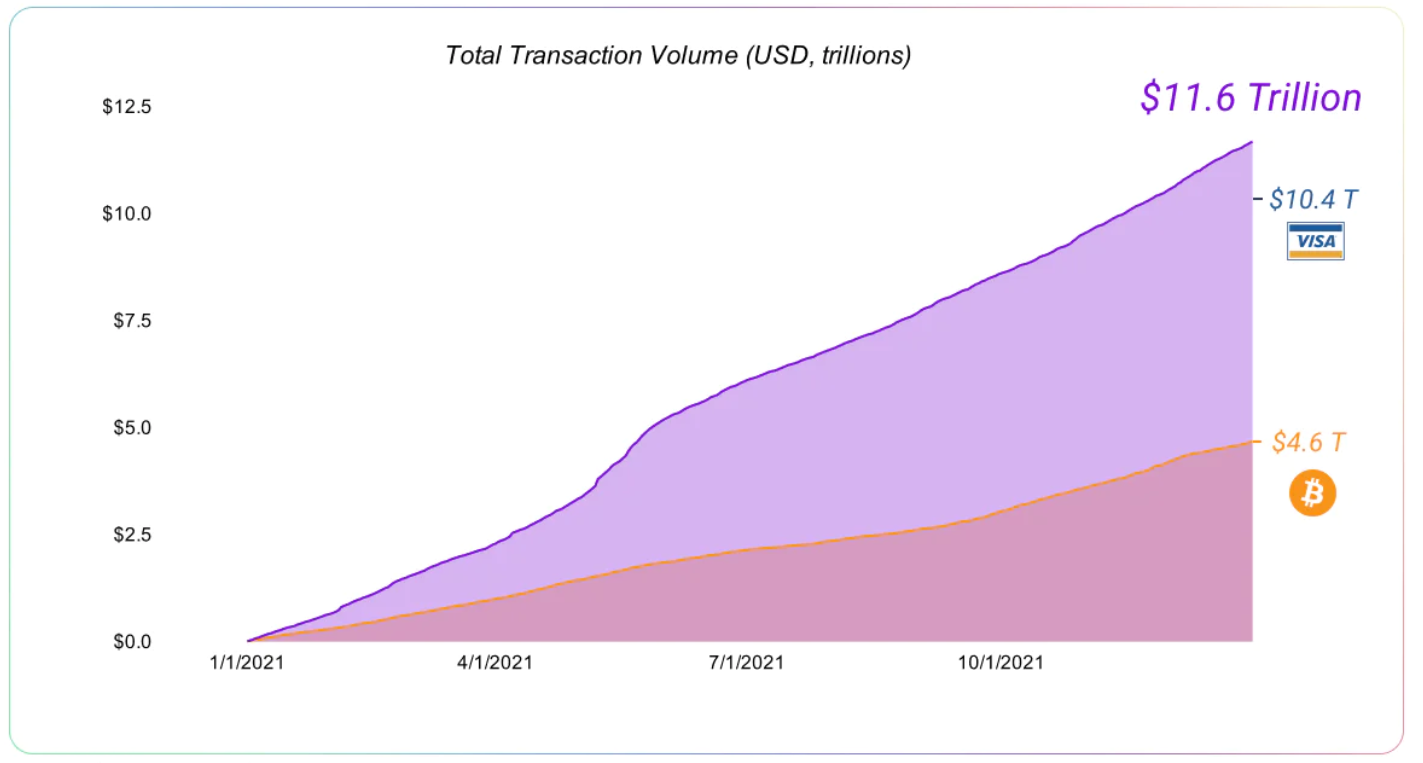
Ethereum (ETH) processed more money than Visa in 2021. Ethereum processed 11.6 trillion dollars in transactions in 2021, compared to 10.4 trillion for the Visa network, according to a report published by Josh Stark of the Ethereum Foundation:
Source : https://cryptoast.fr/ethereum-transite-plus-dargent-visa-2021/
At this point, we can no longer say that crypto-assets (like Ethereum) are not being adopted or are insignificant. The VISA network that we use every day with our bank card now processes less money than the second largest crypto-asset (Ethereum). We are at a stage where it is riskier to bet on failure than on the success of this sector.
—
Banking giant HSBC partners with The Sandbox metaverse. We are seeing more and more major banks turning to the crypto-asset and metaverse industries, even though they openly criticized these industries a few years ago. It is important for these banking companies to pivot. Those that are too reluctant to do so will end up going bankrupt, just like all the companies that refused to adopt the Internet in their business models in the 2000s.
—
Ukraine: President Zelensky signs a crypto-friendly law for the country. Ukrainian President Volodymyr Zelenskyy has signed a law both to regulate and to promote the adoption of cryptocurrencies. Concretely, this will establish a precise legal status for cryptocurrencies and will also allow the country's banks to manage crypto-asset accounts for professionals.
Furthermore, we were able to see that crypto-assets are functional in times of war, but also for international donations, without an opaque trusted third party, with almost no fees, and with an immediate ability for the recipient to use them. More than 52 million dollars crypto-asset donations have been sent to the Ukrainian government.
Fundamental Analysis
Source : https://www.coingecko.com/fr
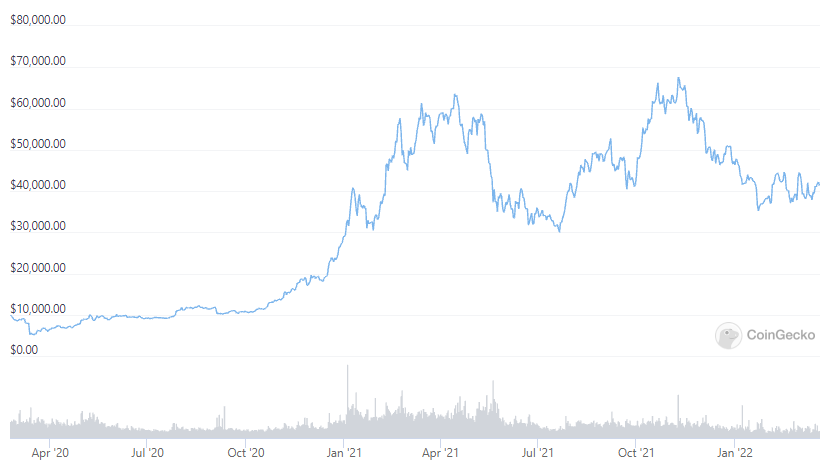
At the time of writing, the price of Bitcoin is 41,300 $ (on 03/21/22).
Over the last few weeks, we have had confirmation of the return in demand, notably regarding chain demand, but also demand on futures markets. We have probably reached a market bottom.
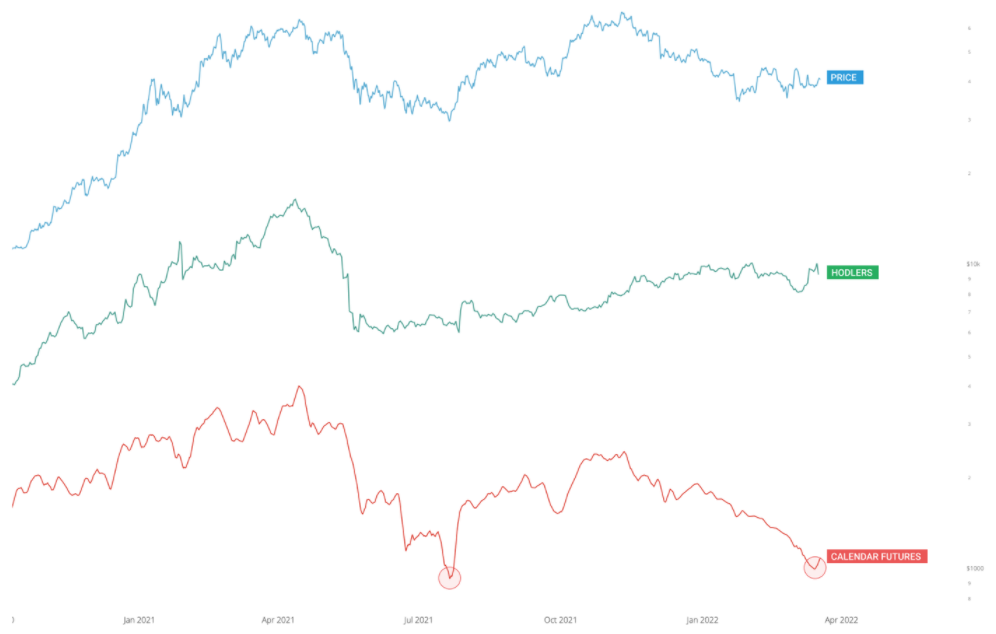
- Long-term cycle (more than 3 months): Demand is flowing into the futures markets, which confirms what we are seeing on-chain data. Lthe request arrives after three months of slow weakening. The signals indicate that we are now in an accumulation zone which characterizes the end of bearish periods.
- Medium-term cycle (3 months): If demand remains stable or continues to rise, a countdown begins for a bullish breakout from the 35,000 $ / 45,000 $ range per bitcoin.
- Short-term cycle (1 month): The very high amount of stablecoins ready to enter the market at the first signs of a bullish reversal could quickly propel prices upwards out of the 35k-45k $ range.
Note that ETH on-chain demand is at its highest level and the situation appears stronger than BTC. We therefore expect Ethereum to outperform Bitcoin in the coming weeks.
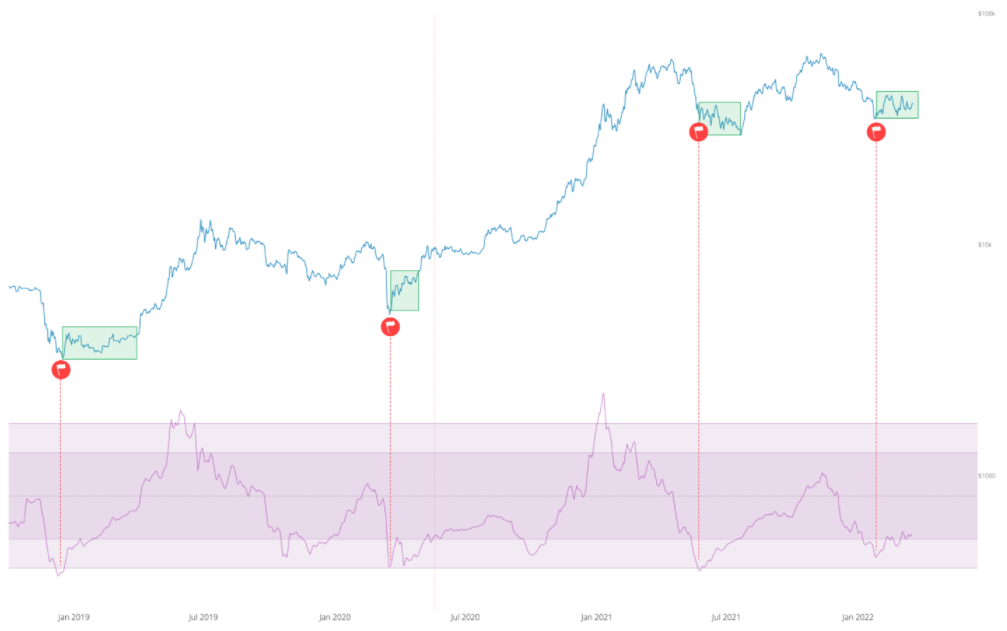
This graph represents a ratio of stablecoins on the sidelines ready to return to the markets when there is a market reversal. In red are the market capitulation events, while the green zones are accumulation areas. The low points on the oscillator indicate maximum amounts of stablecoins on the sidelines. This means we are in a plateau zone with a floor price decided by smart money (institutions). From this floor price, the next bull phase is being prepared.
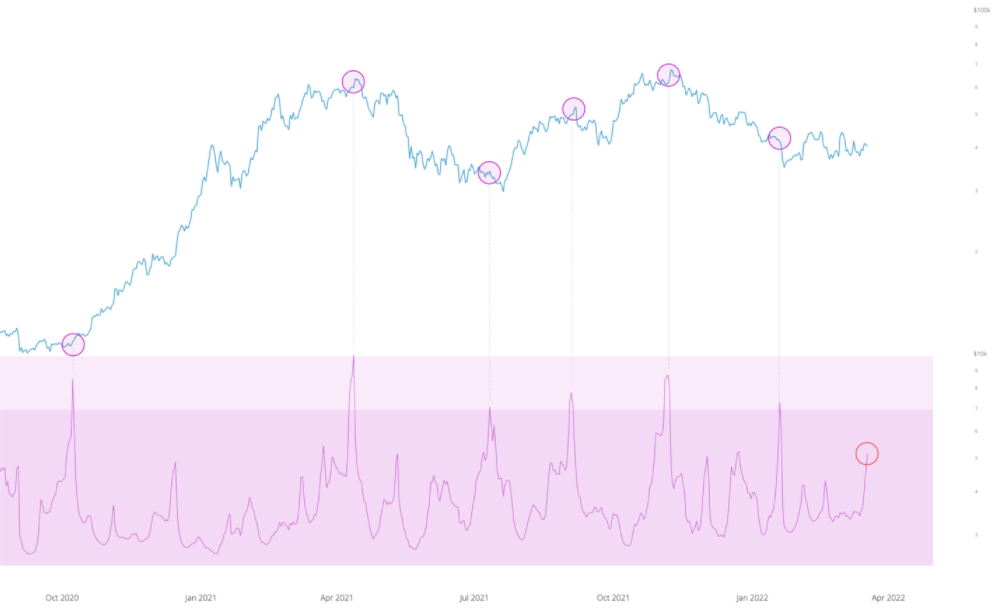
Furthermore, as the chart below indicates, the stability of the bitcoin price indicates that we are close to a strong movement. If this continues, given the influx of demand coming into the market, this represents the characteristics of the final stages of accumulation before a bullish breakout.
If you have any questions, comments, or would like to know more about our service, please feel free to contact us: crypto.assets.manage@gmail.com
— Warning —
This is not investment advice, no one can predict the future.
You are solely responsible for your own investment decisions.
We are not responsible for any losses resulting from a decision made based on the information in this letter.