



Hello everyone,
The purpose of this letter is to inform you about the current situation of the crypto-asset market, as well as recent news in this field. This letter is not investment advice, but merely a sharing of my personal point of view.
News
Using the blockchain without a wallet? Ethereum's EIP-4337 makes account abstraction possible. Account abstraction is designed to allow users unfamiliar with the cryptocurrency ecosystem to navigate Web3 applications with ease without creating a wallet. This technical feat is now possible on blockchains compatible with the Ethereum Virtual Machine (EVM) thanks to the implementation of EIP-4337.
–
Bank run: Bitcoin (BTC) jumps more than 18 % in 24 hours. In response to the bank run originating in the United States, the price of Bitcoin surged by over 18 % in the past 24 hours. Meanwhile, other cryptocurrencies also posted quite respectable performances.
–
USDC depeg: what are the consequences for decentralized finance (DeFi)? The current drop of USDC to $0.9 has led to various consequences in decentralized finance (DeFi). Between the imbalance of Curve (CRV) liquidity pools and the depeg of the DAI stablecoin, we have attempted to compile a non-exhaustive list.
–
AXA giant joins DASP – What impact for the crypto ecosystem? AXA Investment Managers, the AXA Group subsidiary specializing in investment management, has just registered as a Digital Asset Service Provider (DASP).
–
Ethereum: only 9 % of ETH stakers plan to withdraw their funds after the Shanghai upgrade. A new report from Kiln allows us to identify certain observable trends among Ethereum (ETH) community actors who have staked significant amounts of Ether. Thus, we can see that, based on the responses provided by the panel surveyed here, ETH staking is expected to see growing interest following the Shanghai upgrade scheduled for March or April.
–
Move over banks – The former BitMEX CEO proposes a Bitcoin (BTC)-backed dollar stablecoin. Breaking away from the banking system. That is the ambition of Arthur Hayes, the former CEO of BitMEX, who is proposing a stablecoin based solely on Bitcoin (BTC).
–
Elon Musk wants Twitter to become «the largest financial institution in the world». Musk has already mentioned his ambition to make Twitter a «super app» rather than just a social network. Earlier this year, it was learned that Twitter was working on future banking services, and was considering making bank cards and savings accounts available. Furthermore, Musk has not closed the door on cryptocurrencies, which could potentially be compatible in the future.
–
Binance US authorized to buy Voyager Digital's assets, despite SEC opposition. This is a victory for Binance.US in a battle against the Securities and Exchange Commission (SEC). The exchange platform will be able to acquire Voyager Digital's assets for one billion dollars. What will this be used for?
–
Visa confirms its enthusiasm for the crypto and blockchain ecosystem. A recent report stated that the giant Visa was hesitant regarding cryptocurrencies. But the firm confirmed its commitment to the ecosystem, particularly regarding stablecoins.
Fundamental Analysis
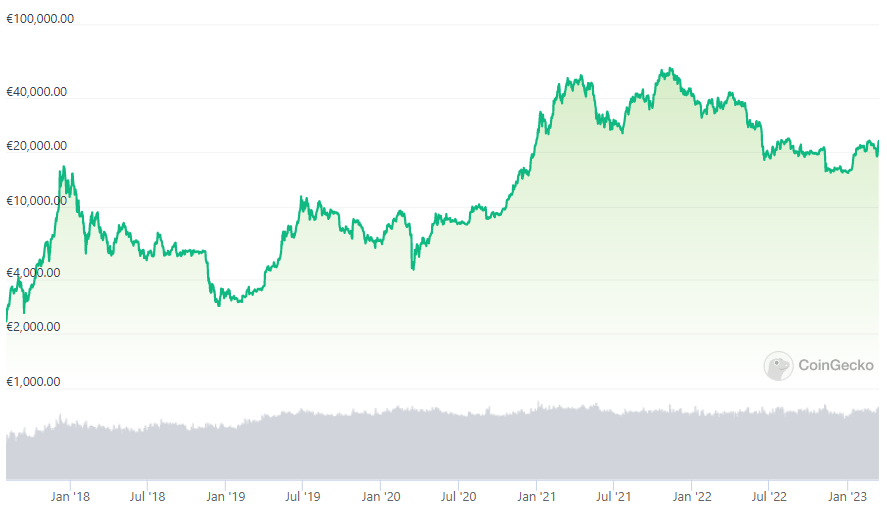
Source : https://www.coingecko.com/fr
At the time of writing, the price of Bitcoin is 24,800 $ (on 03/15/23).
Last week proved to be one of the most important for the digital asset space in 2023. Within a few days, three major banking institutions in the United States entered into voluntary liquidation or were placed into receivership by US regulators.
- Silvergate (SI) : announced its intention to voluntarily withdraw on March 8, in an orderly manner, and to return the entirety of the capital to the depositors.
- Silicon Valley Bank (SIVB) : The 16th largest American bank was closed and placed in receivership by the FDIC on March 12, making the $209 billion bank failure the second largest in US history.
- Signature Bank New York (SBNY) : was also closed on March 12, according to a Federal Reserve announcement about this.
Many large digital asset companies and stablecoin issuers, using one or more of these banking partners, were impacted. Circle, the issuer of USDC, was particularly hit. When they notified that a few $3.3 billion in cash was held at SVB, a temporary break in the $ parity occurred over the weekend, until the announcement of deposit protection by US authorities/regulators.
For all three institutions, it is expected that all deposits will be reimbursed, whether through held reserves or via FDIC deposit guarantees and US regulators. The announcement of the deposit bailout was made earlier in the week. These measures were taken jointly by Treasury Secretary Janet Yellen, the Fed, and the Federal Deposit Insurance Corporation (FDIC) after consultation with US President Joe Biden, according to a press release.
The main response from investors so far, following these bank failures, appears to be a flight to safety into the top, most reliable assets, BTC and ETH.
The failure of these banks following a bank run caused a loss of confidence among depositors and investors in the banking sector.
What happened to the crypto market a few months ago, when all depositors were withdrawing their assets from exchanges due to a lack of trust during the bear market (which is the most difficult period for these entities), is happening today to certain traditional banks. Due to a lack of liquidity following the central banks« »hawkish" policy (fighting inflation, raising interest rates, and reducing liquidity), banks are in a fragile position.
Over the past few days, we’ve seen «money printing» reappear. U.S. banks borrowed 164.8 billion $ from the Fed to ensure liquidity in a single week. This is a new record. The previous record was 111 billion in $ during the 2008 financial crisis.
European banks are not in better shape.
Conversely, the crypto-asset market is doing well: in the middle of a banking crisis, Bitcoin benefited from a 30 % increase this week. This rise represents a collective realization that Bitcoin can succeed in one of its projects: becoming a hedge against inflation and banking crises.
We could say that in a way Bitcoin was invented for this situation. It is for this reason that Satoshi wrote in the first block of the Bitcoin blockchain: ”The Times 03/Jan/2009 Chancellor on brink of second bailout for banks.".
The text is a London Times headline about the British government's failure to stimulate the economy after 2007-2008. The symbolic text was embedded in the creation of the genesis block on the same day as a substantial bank bailout.
15 years later, traditional finance has not solved these problems of the past, and has even amplified them. Crypto-assets will not solve all problems, but let's let them try to solve a few.
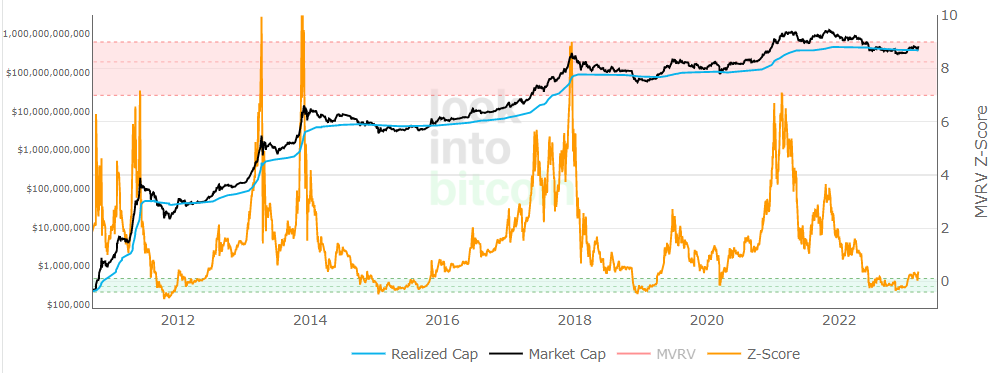
Regarding the next cycle, as we mentioned in our last letter, we are already at the beginning of a new cycle and we are going to move out of the «cheap» zone for digital assets. Below is a long-term chart, called the MVRV Z-Score, using on-chain analysis of the Bitcoin blockchain to identify periods when Bitcoin is extremely over- or undervalued relative to its «fair value.».
We can see in the red band between 6 and 10 the periods when Bitcoin was trading at too high a price, and conversely for the green band between 0 and 1 where Bitcoin was trading at too low a price relative to its fundamentals.
look into bitcoin
This chart allows us to understand at a glance where we stand in the long-term phases of crypto cycles. Most other digital assets follow this same trend of over- or undervaluation driven by the hype effect acting on this asset class.
–
As for macroeconomics, as explained earlier in the letter, we are in the middle of a banking crisis, which is very bad for banks and depositors, as well as life insurance policies.
If we take a step back, we understand that this banking crisis stems from the bond crash we have been witnessing for a year. The bankruptcy of these banks, as well as that of Eurovita, is linked to a bond crisis due to the meteoric rise in interest rates. US banks are sitting on huge unrealized losses. «Unrealized,» because depositors are not (yet) demanding all their funds in life insurance policies or in their banks. But if that were the case, it would be a true Ponzi scheme collapsing.
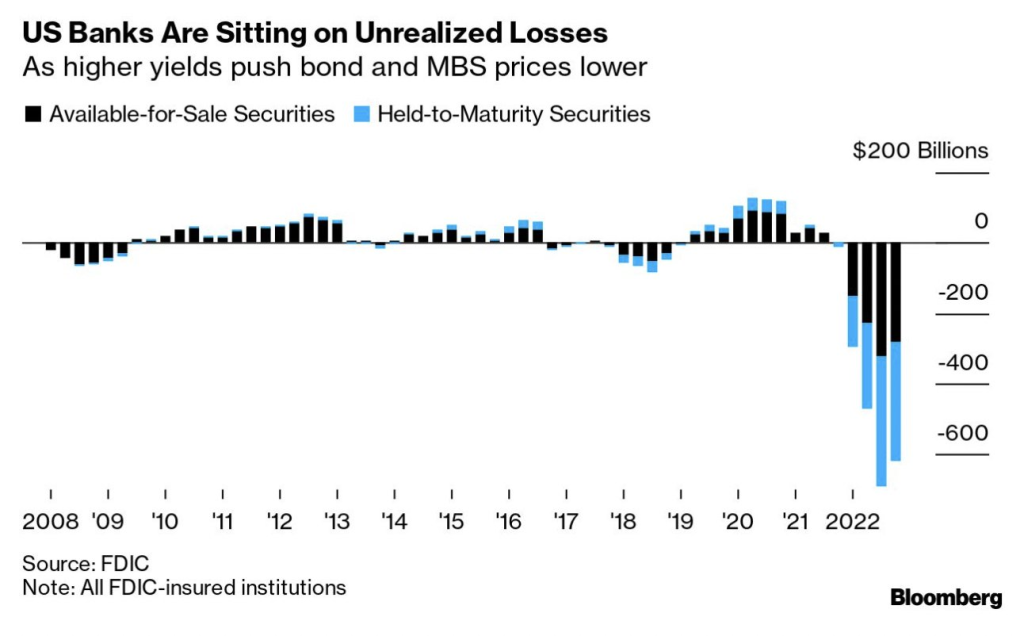
Thus, money printing has started again and is expected to continue, which risks (as we have been saying for a long time in our letters) keeping inflation high in the US and in Europe.
Our service
We offer a discretionary portfolio management service specializing in digital assets. We provide comprehensive support in this space by tailoring your portfolio allocation to your risk profile and situation.
Our turnkey management allows you to take advantage of this sector's growth without worrying about choosing the digital assets to put in your portfolio, conducting in-depth token research, dealing with volatility, or handling rebalancing, etc. All you have to do is read your monthly reports and invest regularly with a long-term horizon (4 years and more).
We do not engage in algorithmic trading or day trading; we invest for the long term in projects that we know and understand. We make monthly rebalancing adjustments in the portfolios and conduct in-depth research on the assets (especially their tokenomics) that we include in our portfolios.
If you have any questions, comments, or would like to know more about our service, please feel free to contact us at this email address: tristan.g@crypto-assets-management.com or to schedule a phone appointment with us via this link.
— Warning —
This is not investment advice, no one can predict the future.
You are solely responsible for your investment decisions.
We are not responsible for losses following a decision made on the basis of the information