



Hello everyone,
The purpose of this letter is to inform you about the current situation of the crypto-asset market, as well as recent news in this field. This letter is not investment advice, but merely a sharing of my personal point of view.
News
Ethereum 2.0 closer than ever? During the Web 3.0 Developer Summit in Shanghai, Vitalik Buterin himself mentioned a arrival of Ethereum 2.0 between August and October 2022! So patience... Ethereum 2.0 should indeed arrive in 2022!
What does the Ethereum 2.0 update bring? To sum it up for you:
- A 98 % reduction in ecological footprint achieved by changing the block validation consensus type. From a Proof of Work (PoW) system to a Proof of Stake (PoS) system.
- Eventually, a reduction in transaction fees on the Ethereum network, notably with layers 2.
- Eventually, with the use of technologies like Sharding and layer 2 solutions, an increase in network capacity.
- A change in Ether (ETH) token metrics that will shift the tokenomics of the Ether token from inflationary to deflationary. Mathematically, this can have the effect of increasing the value of ETH tokens.
This update will be a major achievement for the crypto ecosystem and is the most anticipated event of this year.
Blockchain technology was invented alongside Bitcoin in 2009, which is actually the very first digital asset. Since then, numerous blockchains have allowed many digital assets to operate and fulfill the use cases for which they were created. Beyond its speculative appeal, blockchain remains above all a technology that is increasingly attracting the attention of professionals. A school French was created by Jérémy Wauquier: Alyra offers distance learning courses with a flexible program to become a true expert in this ecosystem, through a curriculum paced by professionals and culminating in a skills certificate.
Despite the downturn in the crypto-asset market, Bitcoin remains the darling of finance giants. PricewaterhouseCoopers (PwC) published a report on the’adoption cryptocurrencies by traditional hedge funds.
And 3 statistics provide an overview of the current and future level of engagement of these funds in cryptocurrencies:
- About a third of the study participants (89 funds) invest in digital assets;
- 57 % of the funds already invested in cryptocurrencies have allocated at least 1% of their assets under management to the sector; ;
- 2/3 of these funds plan to increase their investments in the industry by the end of 2022.
According to these data, these funds, already investing in cryptocurrencies, want to increase their exposure, despite market turmoil.
Brazil: a bill introduced to recognize Bitcoin (BTC) as a payment method. On June 10, a Brazilian congressman introduced a bill aimed at recognizing Bitcoin (BTC) as a payment method. From now on, it is for the Brazilian legislature to deliberate on this bill. Also, its adoption could constitute an important step for the country, which could follow in the footsteps of El Salvador or the Central African Republic.
Fundamental Analysis
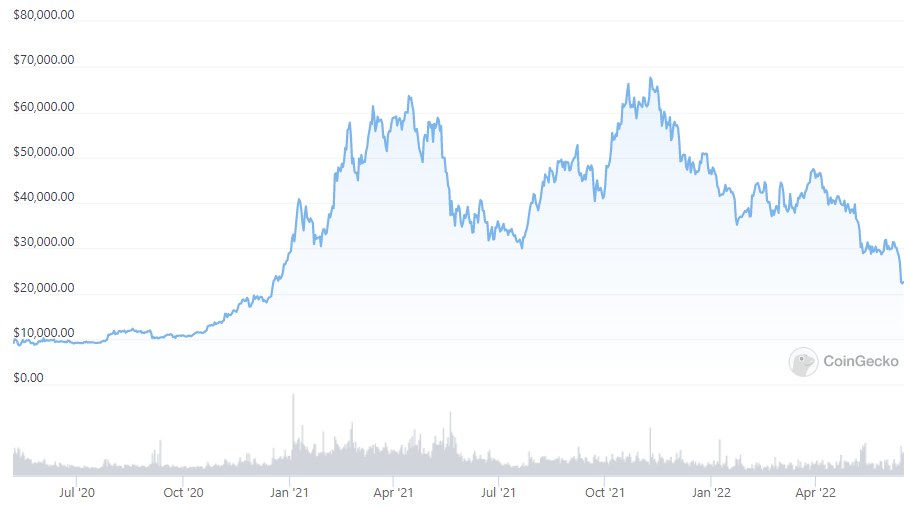
Source : https://www.coingecko.com/fr
At the time of writing, the price of Bitcoin is 21,800 $ (on 06/16/22).
Over the last few weeks, we have witnessed the final phase of the crypto-asset market capitulation. As a reminder: the phases of capitulation are listed on the stock exchange phases accelerating the decline, and they precede a rebound, like a kind of “purge” before sentiment normalizes and a bull market period resumes. During previous cycles, after the capitulation phases, it took several months for the market to recover and start its new major cycle.
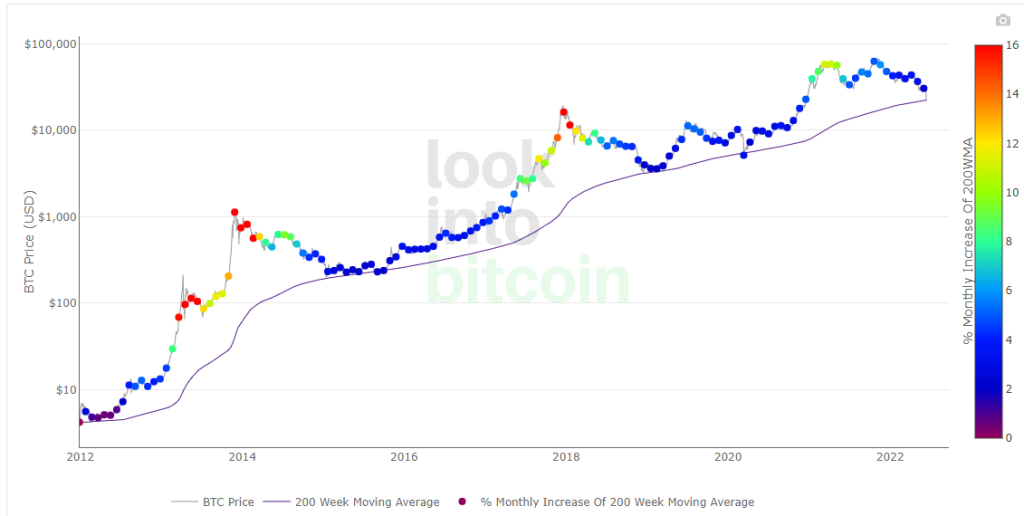
As you can see below, we have entered the deep and painful phase of the bear market. These phases were reached in early 2015, early 2019, and briefly during the Covid-19 crisis in March 2020. These phases have previously lasted between 3 and 6 months before the start of the next cycle. These are generational buying opportunities before the next cycle.
The chart below is a heatmap of Bitcoin's 200-week moving average price in USD. In each of its major market cycles, the price of Bitcoin has historically hit a bottom around the 200-week moving average. This indicator uses colors based on the percentage increase of this 200-week moving average. Depending on the monthly increase in % of the 200-week moving average, a color is assigned to the price chart.
Source : https://www.lookintobitcoin.com/charts/200-week-moving-average-heatmap/
In order for the start of the new cycle to kick off, global geopolitical and inflationary tensions will need to stabilize, as crypto-assets are closely linked to the current economic world.
The crypto-asset market is not the only one experiencing a sharp decline; all stock market indices are down significantly, particularly in the tech sector. One reason for this is that central banks are raising interest rates and reducing quantitative easing (QE). To sum up: central banks are stopping the printing of money due to rising inflation (loss of purchasing power through a generalized increase in prices). There is therefore a liquidity crisis and a deflation of all markets fueled by this money printing.
Nevertheless, the interest rates set by central banks (such as the Fed and the ECB) of wealthy and over-indebted countries (like France at 150% of GDP) cannot increase too much, because if these interest rates rise, it increases the interest these countries must pay on their debt.
As a result, central banks have put themselves in a difficult situation with two choices:
- Either they sharply increase their interest rates to defeat inflation, but the markets collapse and the states can no longer pay their debt interest: so these states go bankrupt. We can already see the initial repercussions of this monetary tightening with the exceptional meeting this Wednesday, June 15, 2022..
- Either they resume the money printing they have applied for the past few decades so that states do not pay the consequences of their over-indebtedness and the markets keep rising: in that case, the bill will be paid by the people in general with high inflation or hyperinflation that will last over time.
Several factors lead us to believe that the second option will be selected. In the meantime, over the long term, crypto-assets will not be impacted by inflation, notably Bitcoin with its supply capped at 21 million tokens. It will continue to establish itself as a store of value over time and on the long term As you can see on the 200-week moving average chart that I showed you previously! In the short term, it is a risky, volatile asset that is heavily impacted by market liquidity, which is why it is periodically correlated with stock indices, which are also impacted by the liquidity injected by central banks.
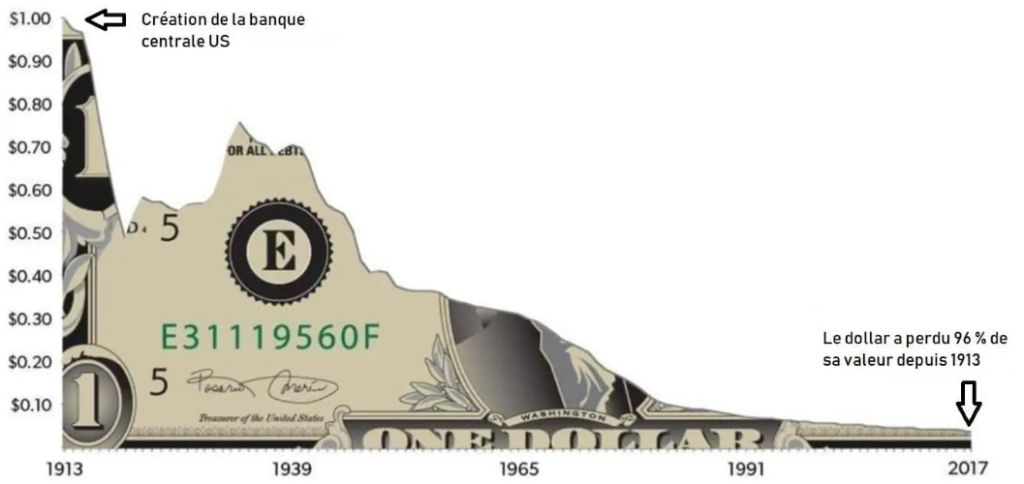
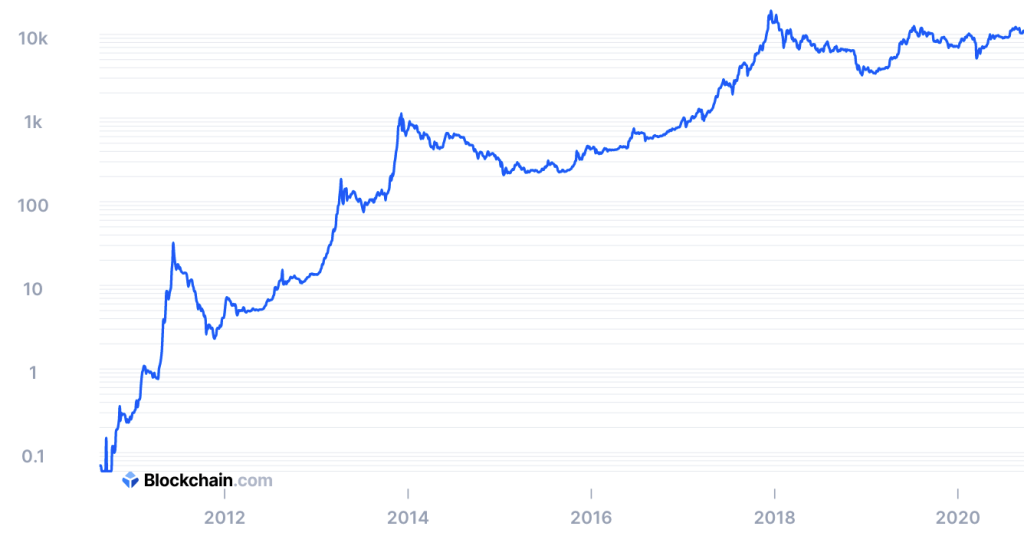
Fiat currencies (euros, dollars, etc.) are non-volatile in the short term, but they lose value in the long term. Some digital assets like Bitcoin (BTC) and others (ETH, BNB, etc.) are very volatile in the short term, but they retain and sometimes even increase their value in the long term.
The two images below make it easy to visualize what I want to explain to you regarding the purchasing power of FIAT currencies (dollars, euros). Obviously, digital assets are newer and they still have many «tests» and periods to go through to validate these assertions over time. That is also what makes it an investment: if it were a certainty, there would be very little volatility, as is the case for gold, which has already proven itself over very long periods.
If you have any questions, comments, or would like to know more about our service, please feel free to contact us: crypto.assets.manage@gmail.com
— Warning —
This is not investment advice, no one can predict the future.
You are solely responsible for your own investment decisions.
We are not responsible for any losses resulting from a decision made based on the information in this letter.