



The objective of this letter: «Dead cat bounce» confirmed; The realized price indicator; Stablecoin expansion is to inform you about the current state of the crypto-asset market as well as recent news in this field. This letter is not investment advice, but merely a sharing of my personal point of view.
News
Why do banks want to kill stablecoin yields? In this dossier, we decode the ongoing debate in Washington between banks and crypto companies regarding stablecoin yields.
–
10 good reasons to adopt Bitcoin without thinking about speculation. Too often, traditional media settle for approaching Bitcoin through a speculative prism. Yet, BTC covers many aspects, each as interesting as the last. Here are 10 news items to talk about Bitcoin without addressing its price, the crash, or losses. Let's explore together the diversity this object of curiosity offers.
–
Nasdaq chooses Kraken to adopt xStocks tokenized shares. While the adoption of tokenized stocks is exploding, Nasdaq has partnered with Kraken’s parent company to integrate xStocks. Let's take a closer look at this major partnership.
–
Kraken becomes the first crypto bank to access the US payment system. Major players in the US cryptocurrency sector are continuing to establish themselves within the traditional financial system, notably by obtaining banking status. Kraken has already been pursuing this activity since 2020 with its crypto bank located in Wyoming, which has just become the first of its kind to open an account with the Federal Reserve.
–
Visa launches stablecoin payments in 100 countries with Bridge. From now on, countries in Europe, Africa, and Asia will be able to use stablecoins as easily as a payment card. This alliance consecrates the power of blockchain and payment networks, and raises the question of the existence of banks.
Fundamental Analysis
Letter No. 49: «Dead cat bounce» confirmed; The realized price indicator; Stablecoin expansion
At the time of writing, the price of Bitcoin is 71,400 $ (on 03/10/26).
The “dead cat bounce” has been validated
In our last newsletter, published in January, we mentioned the possibility of a «dead cat bounce» in the continuation of this bear market. This pattern corresponds to a technical and temporary rebound occurring within an overall bearish trend.
As can be seen below, this scenario has indeed materialized, bearing a strong resemblance to the configuration observed in early 2022. For now, surprising as it may seem, the cycles appear to be repeating with notable precision.
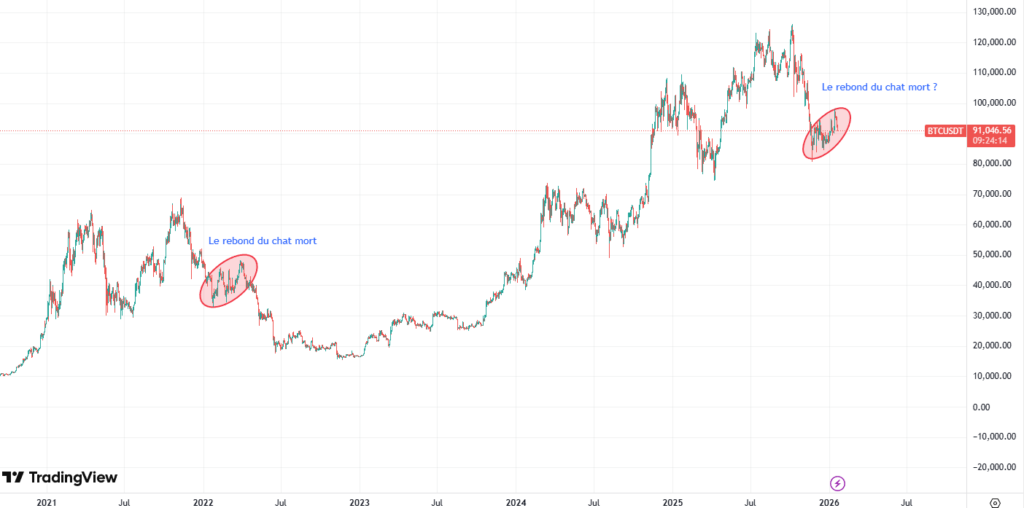
Following our January 2026 letter, the price continued to decline to reach a new consolidation zone between 60,000 and 70,000 $. This zone is interesting, but it is likely not the final zone that the market will reach during this bear cycle.
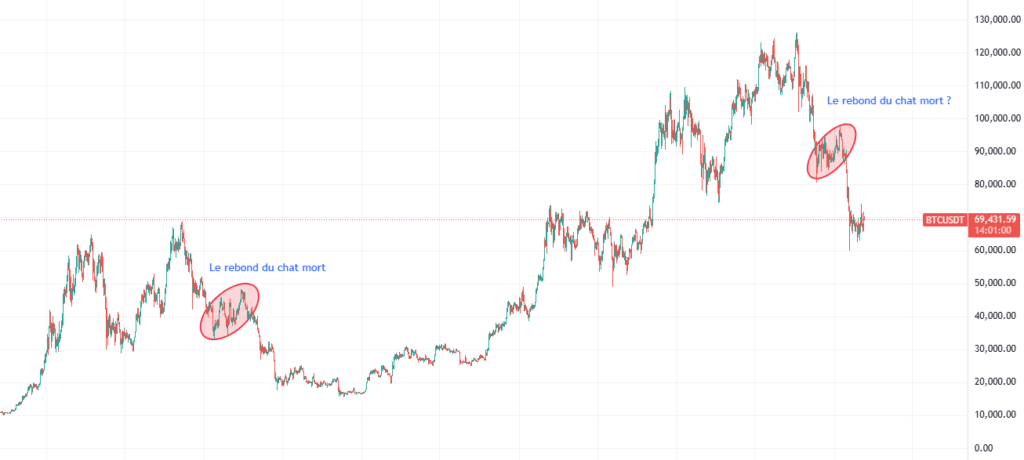
It is possible that a lower zone will be tested, in which the price would probably not remain very long, located rather between 40,000 $ and 55,000 $. These levels could constitute interesting areas to gradually re-expose oneself.
Re-exposure during this bear market must be considered from the perspective of both price and timing.
The Realized Price of Bitcoin: a benchmark to identify interesting accumulation zones
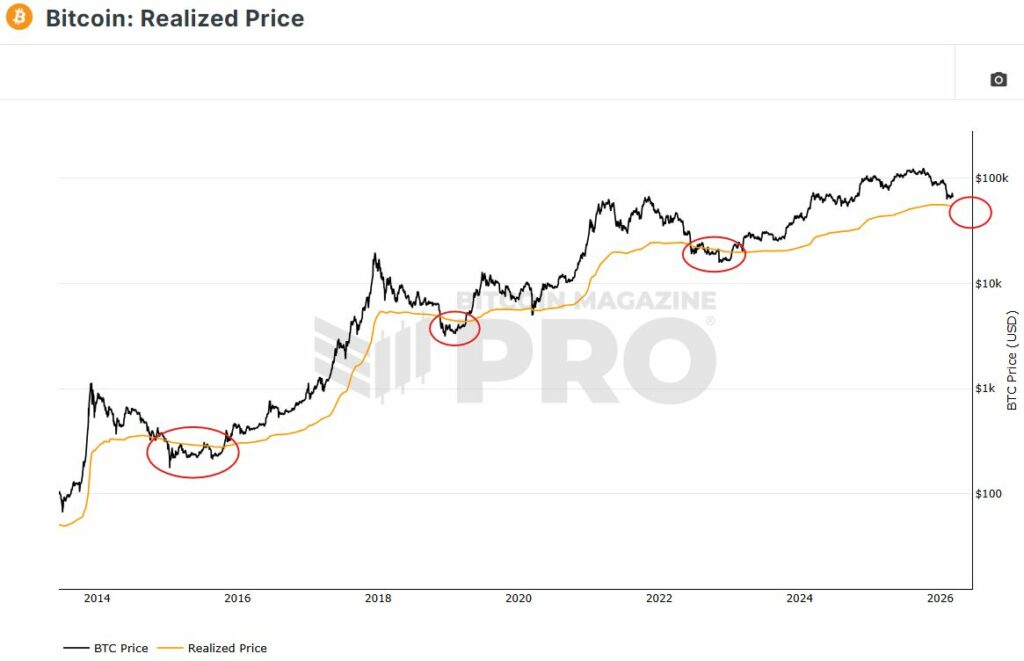
The realized price of Bitcoin is a particularly useful indicator for analyzing market dynamics. It corresponds to the value of all bitcoins evaluated at the price of their last on-chain transaction, divided by the total number of bitcoins in circulation. In other words, this indicator makes it possible to estimate the average price at which currently held bitcoins were acquired or transferred.
During previous cycles, this indicator proved particularly relevant. When the Bitcoin price drops below the realized price, it means that, overall, investors are holding their bitcoins at a price higher than the current market price. The market is then in a state of widespread unrealized losses.
Historically, these periods have often marked the final phases of bear markets and have represented interesting accumulation zones for long-term investors.
Stablecoins are growing despite the bear market
Stablecoins represent one of the major innovations arising from this ecosystem. Alongside Bitcoin, decentralized finance (DeFi), and smart contracts, they represent an essential building block of the financial infrastructure built on the blockchain.
These crypto-assets, generally backed by dollar reserves held in banks or invested in Treasury bills and equivalent instruments, meet a fundamental need of the ecosystem: reducing volatility. In particular, they make it possible to carry out payments or transfers of value while maintaining the stability of a currency like the dollar, while benefiting from the efficiency and speed of blockchain infrastructures.
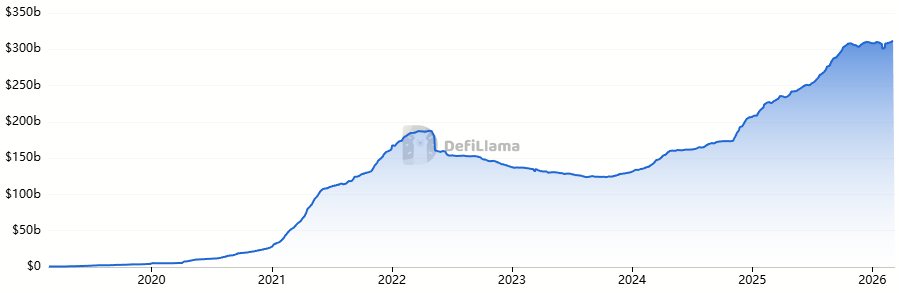
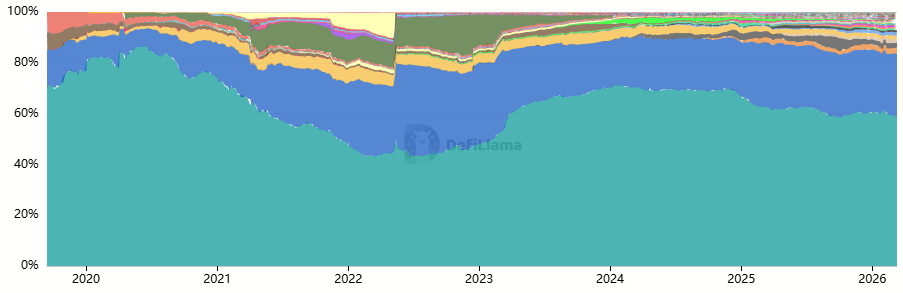
Furthermore, interactions between traditional finance and the crypto-asset ecosystem are multiplying. The business model of stablecoins is progressively encroaching on that of commercial banks, as the latter do not redistribute risk-free rates from central banks to retail savers.
For example, if you hold 1,000 € in a standard bank account, the bank receives the ECB rate on these deposits. With a rate currently around 2 %, this represents about 20 € per year. At the same time, these deposits help increase the fractional reserves of banks, allowing them to expand their financing capacity and market intervention.
In this context, a structural clash is beginning to emerge between the traditional banking model and that of the crypto ecosystem. Contrary to popular belief, it is not so much Bitcoin that finds itself in direct competition with banks, but rather stablecoins and exchange platforms, which could constitute some of the financial infrastructures of tomorrow.
Traditional banks are seeking to preserve a model that has long favored them, notably the ability not to pay interest on retail deposits.Conversely, many crypto platforms try to offer users yields generated by these assets, notably through DeFi. If these structural changes were to materialize, deposits could gradually shift from banks to exchange platforms and thus also feed stablecoins, because on crypto exchange platforms, users generally hold stablecoins.
Finally, the development of stablecoins such as USDC, issued by Circle, or USDT, issued by Tether, illustrates this evolution. These players are gradually capturing a market share historically held by commercial banks. Indeed, the reserves backing these stablecoins are predominantly invested in US Treasury bills. As a result, the yield associated with these assets benefits the stablecoin-issuing companies rather than traditional banks, which, in the conventional system, earn this type of revenue on deposits.
In this context, Stablecoin issuers and crypto exchanges together capture a portion of the value historically captured by traditional banks. As a result, they could lose both risk-free rate revenues (around 2 to 5 % depending on the period) and a portion of the benefits associated with the fractional reserve system.
Our service
At Crypto Assets Management, we offer discretionary portfolio management of digital assets, tailored to your profile. Our strategy is based on the analysis and management of Bitcoin cycles (historically 4 years), favoring investments in long term, monthly arbitrations, and a particular emphasis on tokenomics.
Our Rates

Mereau Finance (Crypto Assets Management) is registered as a Digital Asset Service Provider (DASP) with the Autorité des marchés financiers (AMF) under the number : E2023-084.
— Warning —
This letter is not investment advice.
You are solely responsible for your investment decisions.
Investing in digital assets carries a risk of capital loss, partial or total.