



Reading time of about 15 minutes
Introduction
This work is the result of web research and existing articles; what we are offering you is a pooling of our research in order to help you better understand the project. The web is experiencing an unprecedented technological transition, initially Web 1.0, currently Web 2.0, and soon Web 3.0. This transition is well on its way to profoundly transforming our relationship with digital technology.
Thus, Web 3.0 is the third generation of Internet services for websites and applications. The goal is to offer a semantic Web based on machine understanding of data, with the aim of creating smarter, more connected, and open sites to provide a customized experience
to each user.
The history of Web 1.0 and 2.0
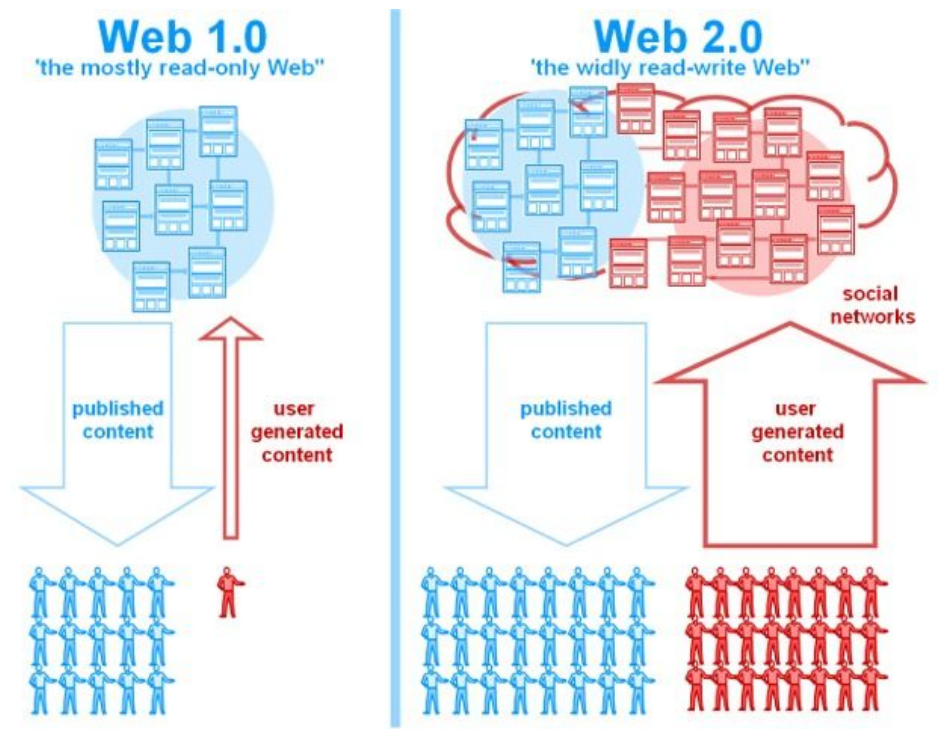
So far, we have lived through two major iterations of the Internet. The first, Web 1.0, marked the beginning of the Internet in the late 1980s, with «read-only» static web pages created by a relatively small number of participants. This was clearly a major breakthrough, allowing anyone in the world to access published content.
But while users could read and browse these web pages, they could not interact with them much beyond that. Furthermore, in the absence of search engines at that time, navigating the World Wide Web (WWW) was not the simple practice we know today.
Thus, Web 1.0 is an information portal where users passively receive information without being able to interact. By 2000, Web 2.0 was underway. While the first iteration mainly involved a single flow of information from the internet publisher to the internet user, this new version allowed for much greater user interaction and participation. Users can create their own accounts in various applications, meaning they have their own unique identity in the online world. They are now able to interact.
This opened up huge opportunities for businesses, particularly for e-commerce, as new internet companies could cheaply market their products and services to a global base of potential online consumers. It also meant that anyone, anywhere in the world, could publish content for a global audience, giving rise to the globally popular blogging trend and fueling user-published sites. And, of course, we must not forget the role of Web 2.0, which facilitated the rise of social media—first with sites like Myspace, and then more explosively with Facebook, Twitter, and YouTube—just as the user-generated content revolution was in full swing.
Thus, Web 2.0 encourages participation, collaboration, and information sharing. In summary, Web 1.0 is the ability for users to read content online, and Web 2.0 is the interaction between these different actors.
Web 3.0
What is it?
Web 3.0 is the new generation of internet technology that relies heavily on deep learning, a branch of artificial intelligence that uses data and algorithms to mimic the way humans learn, gradually improving its accuracy. It will also rely on blockchain technology to ensure the security of a web intended to be decentralized. It will be referred to as a semantic web.
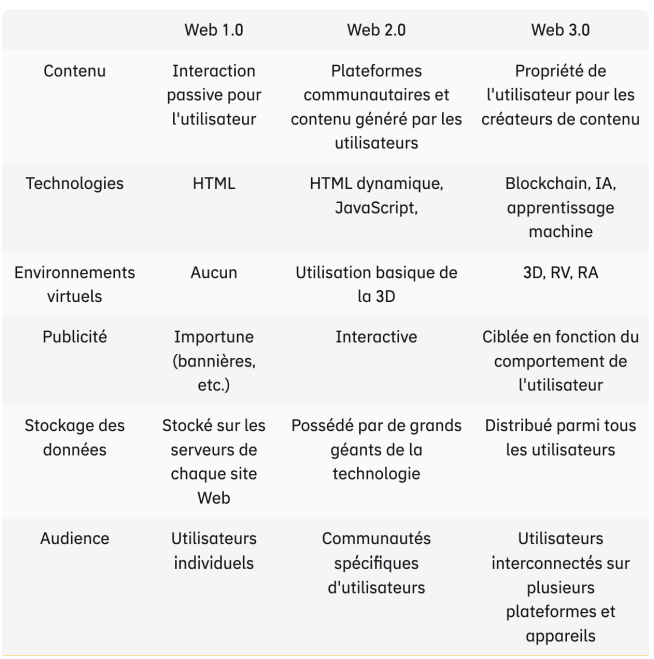
The term was created by Gavin Wood, founder of Polkadot and co-founder of Ethereum. While Web 2.0 focuses on user-generated content hosted on centralized websites, Web 3.0 will give users greater control over their online data. This movement aims to create open, connected, and intelligent applications and websites through better machine comprehension of data via deep learning. This provides a web experience that will adapt to its user.
The decentralization and digital economies proposed by blockchain also play an important role in Web 3.0, as they allow us to assign value to content created on the internet, thereby providing a more immersive version of the Web.
How it works
Thus, thanks to artificial intelligence, Web 3.0 will therefore provide personalized and relevant information more quickly, always with the goal of improving the user experience. This is made possible through search algorithms and the intelligent development of Big Data analytics, via which machines can intuitively understand and recommend content. Web 3.0 will also focus on content ownership and the support of user-accessible digital economies through blockchain.
Current websites generally display static information or user-driven content, such as forums or social networks. While this makes it possible to publish data on a large scale, it does not meet the specific needs of users. A website must adapt the information it provides to each user, much like the dynamic nature of human communication in the real world. With Web 2.0, users lose ownership and control once this information is online.
The benefits
Now that we have emphasized decentralization and value creation in Web 3.0 as well as the role of artificial intelligence in the proposed user experience, let us look at the benefits this will bring compared to the static use of Web 2.0. Thus, the use of:
- Blockchain will enable the elimination of central control points. Indeed, given that
intermediaries are removed from the equation, they no longer control user data. This
liberty reduces the risk of censorship by governments or corporations and reduces the effectiveness of
denial-of-service (DoS) attacks. This also ranges from reducing the risks of data loss and
thus making blockchain a serious competitor to the cloud. - An educational Web via deep learning will lead to an improvement in advertising and marketing by targeting specific audiences accordingly. Indeed, no one likes to be bombarded with online ads; however, if the ads are relevant to your needs, they can be helpful instead of an annoyance. This is made possible by an increased interconnection of information: since more and more products are connected to the Internet, larger datasets provide algorithms with more information to analyze. This can help them provide more precise information that meets the specific needs of each user.
Here is the true power of combining deep learning via artificial intelligence with big data. We will have more efficient navigation, moving from using search engines where finding the best results could be a challenge to more high-performing search engines for finding semantically relevant results based on the search context and metadata. The result is a more practical web browsing experience that allows everyone to easily find the exact information they need.
Artificial intelligence will also enable better customer support. Customer support is essential to the smooth operation of the user experience on websites and web applications. However, due to the considerable costs they generate, many web services struggle to scale their customer service operations. By using smarter chatbots that can talk to multiple customers simultaneously, users can enjoy a superior experience when working with support agents.
The main characteristics of Web 3.0
To sum up, if Web 3.0 wants to be able to provide the innovative services it offers, it will need to take into account 4 key perspectives in order to provide the best possible experience for its users.
- Semantic markup: Over time, machines have improved their ability to understand
data and content created by humans. However, creating a seamless experience where semantics are fully understood will take time. For example, using the word «bad» can, in certain cases, mean «good.» For a machine, this can be incredibly difficult to understand. However, with Big Data and other information to study, AI is beginning to better understand what we write on the web and present it intuitively. - Blockchain and cryptocurrencies: Data ownership, the online economy, and decentralization are essential aspects of Gavin Wood's Web 3.0 future. The blockchain
offers an approved system to achieve many of these objectives. The power for anyone to
tokenizing assets, putting information on a blockchain, and creating a digital identity constitute a major innovation that lends itself to Web 3.0. - 3D visualization: In other words, the appearance of the Web will change radically. We
let us already note a transition towards 3D environments that even integrate virtual reality. The
The metaverse is one of the pioneers of these experiences, and we are already familiar with meetings through 3D video games. The fields of user interface and user experience also make it possible to present information more intuitively for web users. - Artificial intelligence: Artificial intelligence is the key to transforming content created by
the man in machine-readable data. We already know customer service robots,
but this is only the beginning. AI can present us with data and sort it, which makes it a tool
versatile for Web 3.0. Better yet, AI will learn and improve on its own, reducing
thus the work necessary for human development in the future.
Thus, thanks to its 4 points, a user will be able to have a unique experience, optimized according to their needs and profile. They will have a digital identity with which they will have purchasing and development power. They will enjoy a more immersive experience thanks to technological advancements in the field of 3D visualization.
Web 3.0 and cryptocurrency
Blockchain and cryptocurrency have great potential regarding Web 3.0. Decentralized networks are successfully creating incentives for ownership, governance, and more responsible data content creation.
Among the most relevant aspects of Web 3.0 are:
- Decentralization: The transparent diffusion of information and power across a vast set of people is simple with blockchain. This situation contrasts with Web 2.0, where major tech giants dominate vast swathes of our online lives.
- The use of cryptocurrency digital wallets: Anyone can create a wallet that allows them to make transactions and act as a digital identity. You do not need to store your information or create an account with a centralized service provider. You have full control over your wallet, and often the same wallet can be used across multiple blockchains.
- The digital economy: The possibility of owning data on a blockchain and using decentralized transactions creates new digital economies. They allow us to easily evaluate and exchange goods, services, and content online without having to provide banking or personal data. This openness helps improve access to financial services and allows users to start earning money.
- Interoperability: DApps and on-chain data are becoming increasingly compatible. Blockchains built using the Ethereum Virtual Machine can easily support DApps, wallets, and tokens from different blockchains. This helps improve the omnipresence needed for a connected Web 3.0 experience.
Web 3.0 today
Artificial intelligence
It is interesting to understand that the use of artificial intelligence and deep learning in Web 3.0 is not limited solely to the analysis of data from various users.
Let's take the example of Apple's Siri and Amazon's Alexa, both of which offer virtual assistants that check most of the Web 3.0 boxes. AI and natural language processing help both services better understand human voice commands. The more people use Siri and Alexa, the more their AI improves its recommendations and interactions. This makes them a perfect example of a semantically intelligent web application belonging to the world of Web 3.0.
Smart connected home
One of the main features of Web 3.0 is ubiquity. This means that we can access our online data and services across multiple devices. The systems that control your home's heating, air conditioning, and other energy sources can now do so in an intelligent and connected way. Your smart home can know when you leave, when you arrive, and how warm or cool you like your home to be. It can use this information, and much more, to create a personalized experience. You can then access this service from your phone or other online devices, wherever you are.
Conclusion
The evolution of the Internet has been a long journey and will surely continue toward other iterations. With the massive explosion of available data, websites and applications are evolving toward a more immersive web experience, more specific to each user. Although there is still no concrete definition for Web 3.0, innovations are already in motion. Thus, we are on the road to a semantic web, a web that will offer a unique and personalized experience to each user, relying on the analysis of their data.
However, issues related to latency, scale, and reliability still pose significant challenges in the transition to Web 3.0; companies aspiring to improve the Internet will help resolve these issues while stimulating broader adoption of DApps and the decentralized Web. The positive network effects resulting from growing adoption will continue to amplify the benefits of Web 3.0, which in turn will lead to increased adoption.