



The objective of this letter:« Toward the end of the bear market? ; The rise of RWAs and the structural constraints of utility tokens» is to inform you about the current state of the crypto-asset market as well as recent news in this field. This letter is not investment advice, but merely a sharing of my personal point of view.
News
11% of French people hold cryptocurrencies – Who are they and what are their strategies? The Adan has just published its «2026 barometer» on cryptocurrency adoption in France. The document highlights a structural stabilization in the number of holders, while noting that significant potential for development remains. Let's take a look...
–
Morgan Stanley's Bitcoin ETF launch is becoming the best in its history. US bank Morgan Stanley officially launched its spot Bitcoin ETF (MSBT) late last week. It was a successful operation, as this exchange-traded fund has already posted an all-time high for its first day of trading.
–
Towards an even more centralized crypto regulation in Europe? The ECB gives its opinion. Ultimately, the monitoring of crypto players in Europe could become even more centralized, according to the ECB's latest report. What is currently at stake?
–
Taxes 2026: what's changing for the 2025 income tax return. The 2025 income tax reporting campaign has been open since yesterday in France. What are the changes in the 2026 tax return?
–
Bitcoin ETFs maintain strong activity – Crypto recap of the night of April 8 to 9, 2026. A night marked by high market activity, progress in crypto ETFs, and new political statements in the United States. A look back at the sector's main news between regulation, liquidity, and volatility.
Fundamental Analysis
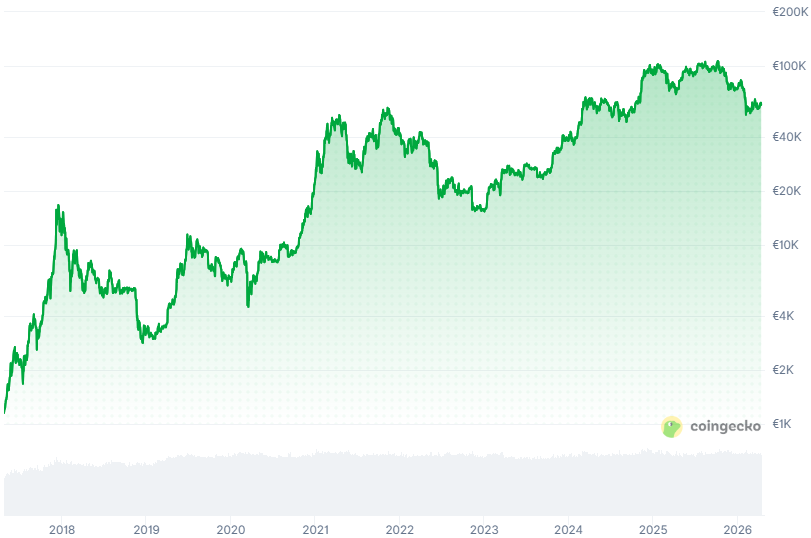
Letter No. 50: Towards the end of the bear market?; The rise of RWAs and the structural constraints of utility tokens
At the time of writing, the price of Bitcoin is 71,400 $ (on 04/13/26).
Toward the end of the bear market, how to reposition oneself?
We have been in a bear market since early October 2025, which is now more than six months. Historically, these phases generally span a duration of 10 to 12 months.. In this context, the year 2026 appears to be a favorable period for reinvestment, with a phased deployment of capital, based on both time and price movements. Waiting until 2027 or aiming for excessively low entry points carries a significant risk: that of missing part of the next bull cycle.
Initially, repositioning seems more relevant in Bitcoin, which historically is the first asset to initiate a bullish reversal coming out of a bear market. However, as in previous cycles, certain altcoins can reach their low point more quickly, sometimes before Bitcoin, while only rebounding at a later stage. It is therefore possible to begin gaining exposure to them, but in a gradual and selective manner, favoring solid projects with identifiable value capture mechanisms and for which the level of conviction is high.
An analysis of past cycles on the Glassnode chart below, which superimposes cycles 2, 3, 4, and the current cycle, highlights relatively similar dynamics. The optimal reinvestment zones, although broad, are clearly identifiable and generally span a period of 6 to 10 months. Delaying one's reinvestment beyond these zones (particularly toward the end of 2026 or early 2027) means taking the risk of having to deploy capital urgently and potentially missing a significant part of the bull phase. These zones are never perfectly defined, which implies accepting a certain degree of fuzziness and spreading one's exposure over time, even if it means acting slightly earlier.
Similarly, waiting for overly aggressive price levels (for example, 40,000 $ or 30,000 $) can prove risky if those levels are never reached. During the 2022 market bottom, many investors stayed out of the market for this reason, thus missing the start of the next cycle.
In practice, This reinvestment phase must fit into a matrix logic, combining both price and temporality criteria, to optimize capital deployment. Trying to find the exact bottom is generally a mistake.
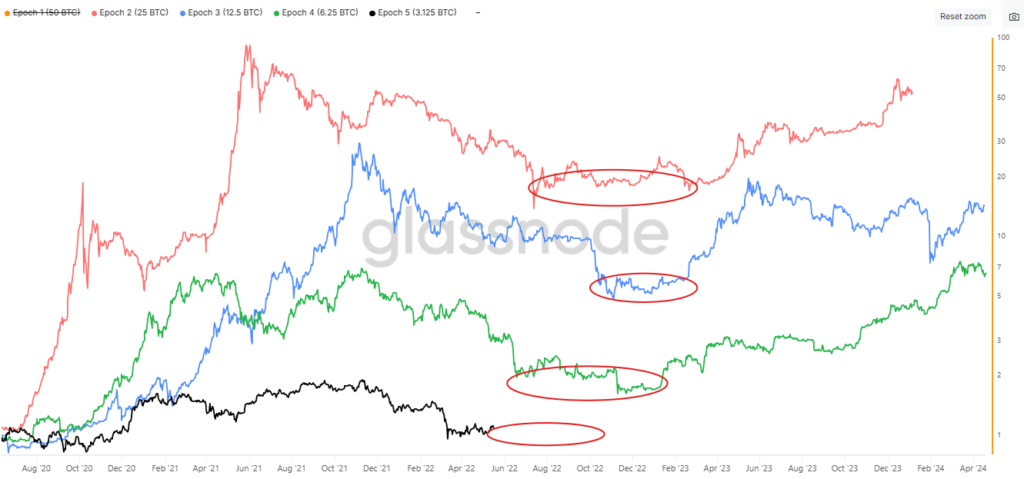
Superposition of cycle performances since halvings – Glassnode
The major structural constraint weighing on utility tokens
Within the crypto-asset ecosystem, there are several distinct sub-categories.
First of all, Bitcoin occupies a place of its own. It has a unique value proposition and is not perceived by the market as a classic crypto-asset. It is gradually establishing itself as «digital gold,» a long-term store of value meeting a real need different from other crypto-assets.
Next, a distinction is made for altcoins, which are all crypto-assets other than Bitcoin. These assets are predominantly utility tokens, whose function is linked to the use of a protocol or a network. They can, for example, allow participation in the governance of a DAO, grant access to a share of a protocol's revenues, or be necessary to use a blockchain or a specific service. In our approach, we exclude NFTs as well as security tokens, meaning tokens representing traditional assets (tokenized stocks, tokenized gold, etc.).
These utility tokens are currently facing a major structural constraint that weighs on this entire asset class. This issue directly concerns value capture as well as the rights associated with token investors.
Unlike traditional finance, where shareholders have clearly defined legal rights regarding income streams, cash flow, and governance, token holders operate in a more uncertain framework. Value creation and distribution mechanisms rely primarily on coded rules, defined by the founding teams, rather than a structured legal framework.
These mechanisms can be partially opaque and, in some cases, modifiable outside the protocol (off-chain), which introduces additional risk for investors. Thus, governance tokens mainly confer a voting right on the evolution of the protocol (upgrades, forks), without guaranteeing clear and secure access to the generated economic value. Value capture mechanisms, such as staking or buyback programs, exist, but remain poorly standardized and insufficiently regulated legally.
The rise of RWAs
In our last newsletter, we talked about the rise of stablecoins; there is another underlying trend that is strengthening: the boom in RWAs (Real World Assets), which is the tokenization of assets from traditional finance.
RWAs consist of representing «real» assets on the blockchain such as bonds, stocks, real estate, or private credit. Unlike utility tokens, these assets do not rely solely on usage or governance, but on tangible and identifiable economic flows. They thus introduce a form of continuity between traditional finance and the crypto ecosystem.
This dynamic has accelerated sharply in recent months. As illustrated in the chart below, the total value of tokenized assets is experiencing sustained growth, with a gradual diversification of sub-categories: bonds, private credit, equities, real estate, and commodities. This expansion is no longer limited to a specific segment, but reflects a more global adoption of tokenization as a financial infrastructure.
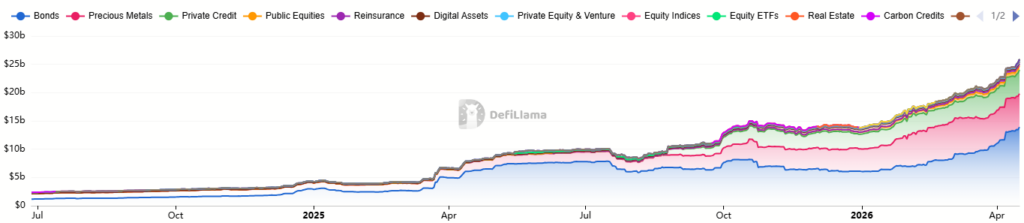
A particularly notable element is the rise of yield-generating assets, notably bonds and private credit. In an environment where investors are seeking greater visibility and stability, these instruments offer a clear alternative to utility tokens, whose value-capture mechanisms often remain uncertain.
Furthermore, this growth is accompanied by a transformation of the investor profile. Where previous cycles were largely driven by speculative flows, the development of RWAs is gradually attracting more institutional capital, which is sensitive to the quality of the underlying assets and the predictability of financial flows.
This evolution has direct implications for the crypto-asset market. A portion of the capital that historically went into altcoins can now be captured by these new hybrid instruments. Indeed, RWAs offer a clearer value proposition: exposure to traditional assets combined with the technological benefits of blockchain (liquidity, transparency, accessibility).
RWA primarily make it possible to transfer traditional financial infrastructure (complex, costly, and inefficient) to blockchain-based rails, offering faster, programmable, less costly processes that are better suited to compliance requirements.
However, this trend does not mean the disappearance of utility tokens. Rather, it marks a rising standard of expectations in the market. In an environment where tokenized assets offer clear yields and established economic rights, Crypto protocols must now demonstrate their ability to credibly generate and redistribute value.
Thus, The growth of RWAs is not just a new narrative, but a structural change. It is redefining investment standards in the ecosystem, progressively bringing the logic of crypto-assets closer to that of traditional financial markets.
Our service
At Crypto Assets Management, we offer discretionary portfolio management of digital assets, tailored to your profile. Our strategy is based on the analysis and management of Bitcoin cycles (historically 4 years), favoring investments in long term, monthly arbitrations, and a particular emphasis on tokenomics.
Our Rates

Mereau Finance (Crypto Assets Management) is registered as a Digital Asset Service Provider (DASP) with the Autorité des marchés financiers (AMF) under the number : E2023-084.
— Warning —
This letter is not investment advice.
You are solely responsible for your investment decisions.
Investing in digital assets carries a risk of capital loss, partial or total.