



The objective of this newsletter: «Méreau Finance obtains its PSCA registration — The mildest bear market ever recorded to date« is to inform you about the current state of the crypto-asset market as well as recent news in this field. This letter is not investment advice, but merely a sharing of my personal point of view.
News
Méreau Finance obtains its PSCA license! ✅
🎉 We are very proud to announce that Crypto Assets Management, which becomes Méreau Finance, obtained its accreditation PSCA pursuant to the European regulation MiCA, under the number A2026-025.
This authorization marks the culmination of more than a year of work and allows us to continue our crypto-asset discretionary portfolio management activity within a demanding European regulatory framework.
We are pleased to join the still exclusive circle of PSCA-approved companies in France and reaffirm our ambition: to offer long-term management based on fundamental analysis, market cycle management, and rigorous risk control.
This step opens a new chapter for Méreau Finance. We look forward to continuing this adventure.
📩 If you currently hold crypto-assets on a platform that does not have a CASP (MiCA) authorization, or if you wish to check its status, you can consult the European register available at CASP Tracker or directly on the website of AMF.
If your platform is not a CASP (MiCA) licensed entity, we can assist you in migrating your assets to our licensed solution and setting up discretionary portfolio management tailored to your investment objectives.
The next big evolution of Bitcoin will not come from its protocol, according to Michael Saylor. Even though its adoption by traditional finance clearly changes the outlook regarding Bitcoin, this does not really concern its protocol, which is intended to remain as fixed as possible. Because, in a world where everything is constantly and rapidly evolving, «its goal is to go slowly and not break things,» according to Michael Saylor.
–
Germany: millions of people will soon be able to trade cryptocurrencies directly through their banks. Long reluctant, German banks are changing their stance on cryptocurrencies. Savings banks and cooperative banks are preparing to open crypto trading to tens of millions of retail clients, and to do so without going through a third-party platform.
–
The Turkish lira has fallen by 15 % in one year; savers are turning to stablecoins and cryptocurrencies. The Turkish lira continues to depreciate against the dollar as inflation continues to erode the purchasing power of households. Faced with this double pressure, a growing number of savers are turning to cryptocurrencies, primarily stablecoins, which offer exposure to the dollar that is more accessible than traditional financial solutions.
–
The strategic Bitcoin reserve promised by Donald Trump is facing bureaucratic hurdles. Promised at the time of his election, Donald Trump's strategic Bitcoin reserve is still encountering significant obstacles within the US administration. The reasons: persistent legal hurdles and ministerial competition to gain control of its management.
–
CLARITY Act: here is the next date to remember for crypto regulation in the United States. While the CLARITY Act is stalling in the United States, an upcoming deadline could occur on August 7 to advance this crypto regulation. What is the status?
–
Crédit Agricole bets on crypto after the departure of its anti-Bitcoin boss. One year after Philippe Brassac's departure, Crédit Agricole is accelerating in crypto: EURXT stablecoin, MiCA approval, and the potential acquisition of Meria.
Fundamental Analysis
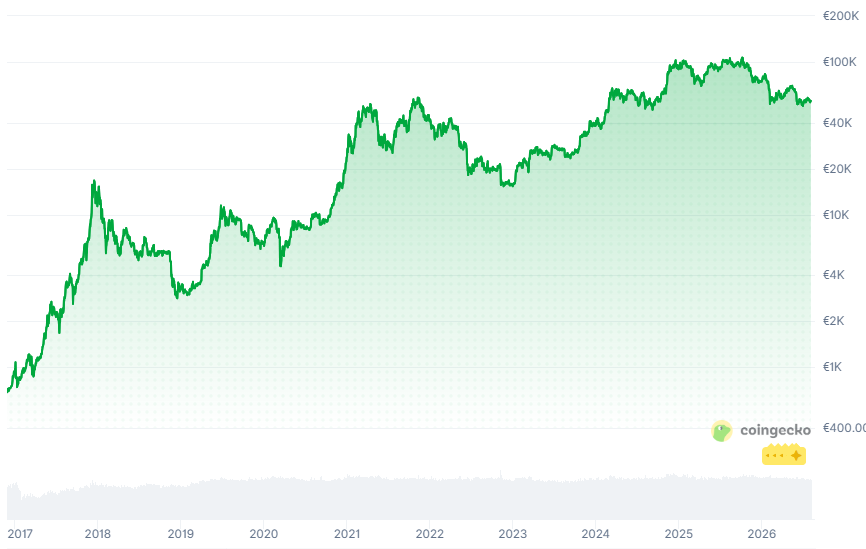
Letter No. 52: Méreau Finance obtains its CASP license — The «softest» bear market ever recorded to date
The price of Bitcoin at the time of this letter is 64,000 $ (August 5, 2026).
The «mildest» bear market recorded to date
The bear market we have been navigating since October 2025 appears, at this stage, to be the «mildest» bear market we have experienced across the various Bitcoin cycles.
This evolution was relatively predictable. As we already mentioned in previous letters, the gradual increase in the size of the crypto-asset market was bound to mechanically reduce the magnitude of cycles, both during bull and bear phases.
The larger and more mature a market becomes, the greater the capital required to trigger large-scale price movements. With a total capitalization of around $2.25 trillion, the crypto-asset market remains relatively small compared to the bond, stock, real estate, or gold markets. However, it is no longer the very small ecosystem of a few hundred billion dollars that we knew during previous cycles.
This growth mechanically leads to greater inertia: movements gradually become less violent, both upwards and downwards. This is precisely what we are observing during the current cycle.
The chart below, from Glassnode, visualizes this evolution. It measures Bitcoin's price deviation from its 200-day moving average, thus allowing a comparison of the magnitude of bear phases across different cycles.
The orange curve, corresponding to the current cycle, clearly shows a correction of a smaller magnitude than in previous bear markets. So far, Bitcoin has reached a maximum drawdown of approximately -33 % relative to its 200-day moving average, versus approximately -50 %, -55 %, and up to -75 % during previous cycles.
In other words, the current bear market remains very real, but its severity is noticeably lower than what has been observed historically. In our view, this gradual decrease in the magnitude of corrections is one of the natural consequences of the growth and maturation of the crypto-asset market.
Unlike previous bear markets, Bitcoin is still trading relatively close to its 200-day moving average, despite spending nearly 270 days below it.
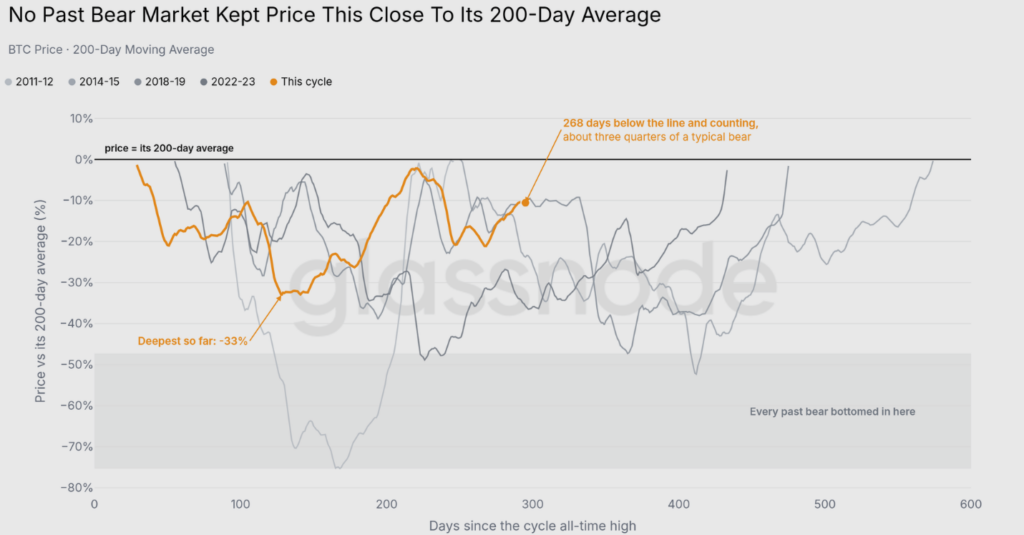
Bitcoin's price deviation from its 200-day moving average (in %) — Source: Glassnode.
A bear market that is longer than it is deep?
We can also observe this decrease in cycle amplitude on this second Glassnode chart, which this time measures Bitcoin's decline relative to the peak reached during each cycle.
Here too, the trend is particularly visible. The orange curve, corresponding to the current cycle, shows a markedly less deep correction than those observed during previous bear markets.
At this stage, we do not believe Bitcoin is destined to drop significantly below the lows already reached during this cycle. A one-off drop obviously remains possible, but a correction on the order of -60 % relative to the all-time high seems unlikely to us at this time, and even more so a return to -75 % to -80 % observed during previous cycles.
On the other hand, while the downturn could be less severe, the bear market may still last for several months. The chart helps to visualize precisely this temporal dimension: our central scenario remains that of a relatively flat, slow, and lacking momentum until the end of 2026, with potentially several intermediate rebound and correction phases.
Therefore, the risk seems to us today to be more related to duration of the bear market than its depth.
The beginning of 2027 could then mark the gradual return of a more favorable dynamic, with a resumption of capital flows and a gradual rise in prices. In this scenario, a return of Bitcoin toward its previous highs could occur during 2027 or 2028, before setting new highs thereafter.
With a maximum decline of approximately 49 %, the current bear market remains significantly less severe than those in previous cycles, during which corrections reached 70 to 80 %.
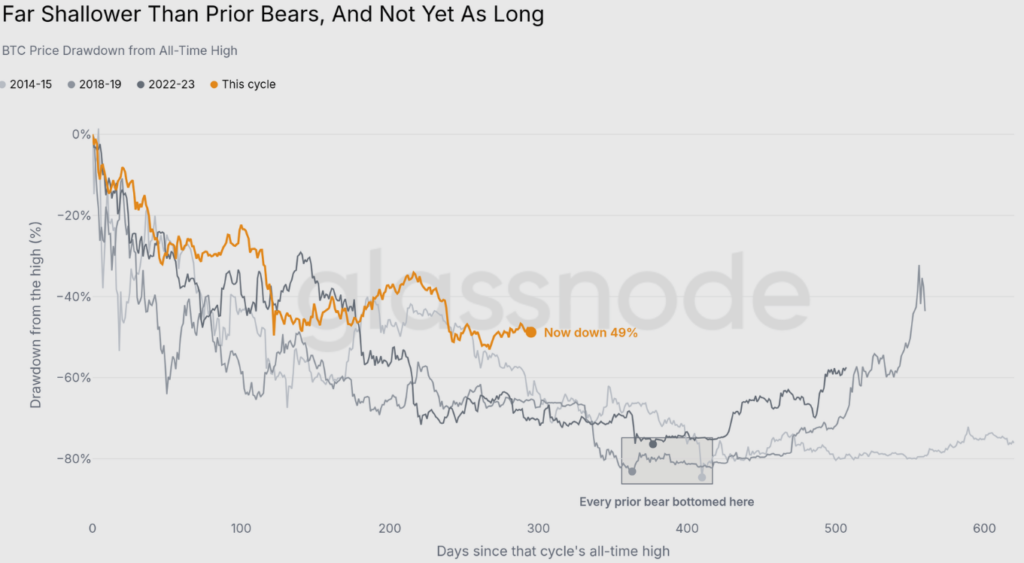
Maximum decline in the price of Bitcoin from its all-time high (in %) — Source: Glassnode.
A historically favorable volatility compression
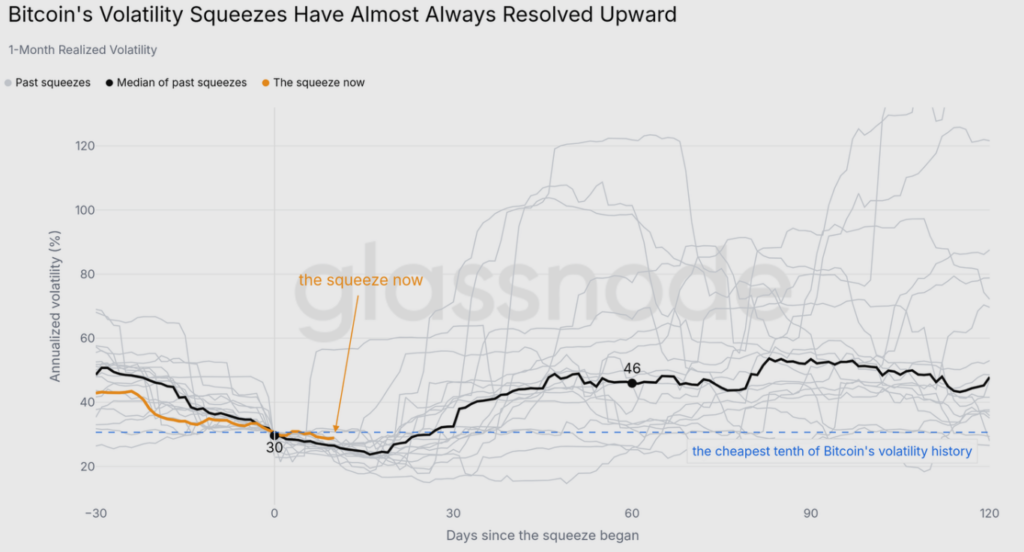
History also gives us a rather encouraging signal. When one-month realized volatility has reached comparable compression levels in the past, the exit from this phase has very often been accompanied by a significant movement, historically with a rather bullish bias. This is probably one of the most positive elements of the current situation. After several months of a bear market and a long period during which prices gradually lost volatility, the market seems to be entering an advanced compression phase. This type of situation generally cannot last indefinitely: the more volatility contracts and the more investors lose interest in the market, the greater the potential for a significant movement when the balance finally breaks.
Nevertheless, caution remains necessary in interpreting this signal. During previous cycles, compression phases generally occurred in an environment where demand was already beginning to return gradually. Today, the context is different: the market remains relatively underinvested, flows are weak, and risk appetite stays limited. We therefore believe that the conditions allowing for the building of a bottom are progressively falling into place, but that they are probably not all met yet to confirm the start of a new bull market.
In particular, we will monitor the sustainable return of inflows, especially via ETFs, as well as a pickup in volatility following this long period of compression. In our view, the combination of these elements would represent a much stronger signal that we are exiting this late bear market stabilization phase. In the meantime, the market may still remain in a relatively flat and sluggish environment for several weeks or months. This is often a frustrating period for investors, but it is historically important for building a new cycle and reinvesting in this market.
Our service
At Crypto Assets Management, we offer discretionary portfolio management of digital assets, tailored to your profile. Our strategy is based on the analysis and management of Bitcoin cycles (historically 4 years), favoring investments in long term, monthly arbitrations, and a particular emphasis on tokenomics.
Our Rates

Méreau Finance is authorized by the Autorité des marchés financiers (AMF) as a crypto-asset service provider (CASP), in accordance with the European MiCA regulation, under registration number A2026-025.
— Warning —
This letter is not investment advice.
You are solely responsible for your investment decisions.
Investing in crypto-assets carries a risk of partial or total capital loss.